Sunday, March 30, 2008
Letter to Bishops
My dear Brother Bishops,
With great trust and hope, I am consigning to you as Pastors the text of a new Apostolic Letter "Motu Proprio data" on the use of the Roman liturgy prior to the reform of 1970. The document is the fruit of much reflection, numerous consultations and prayer.
News reports and judgments made without sufficient information have created no little confusion. There have been very divergent reactions ranging from joyful acceptance to harsh opposition, about a plan whose contents were in reality unknown.
This document was most directly opposed on account of two fears, which I would like to address somewhat more closely in this letter.
In the first place, there is the fear that the document detracts from the authority of the Second Vatican Council, one of whose essential decisions – the liturgical reform – is being called into question. This fear is unfounded. In this regard, it must first be said that the Missal published by Paul VI and then republished in two subsequent editions by John Paul II, obviously is and continues to be the normal Form – the Forma ordinaria – of the Eucharistic Liturgy. The last version of the Missale Romanum prior to the Council, which was published with the authority of Pope John XXIII in 1962 and used during the Council, will now be able to be used as a Forma extraordinaria of the liturgical celebration. It is not appropriate to speak of these two versions of the Roman Missal as if they were "two Rites". Rather, it is a matter of a twofold use of one and the same rite.
As for the use of the 1962 Missal as a Forma extraordinaria of the liturgy of the Mass, I would like to draw attention to the fact that this Missal was never juridically abrogated and, consequently, in principle, was always permitted. At the time of the introduction of the new Missal, it did not seem necessary to issue specific norms for the possible use of the earlier Missal. Probably it was thought that it would be a matter of a few individual cases which would be resolved, case by case, on the local level. Afterwards, however, it soon became apparent that a good number of people remained strongly attached to this usage of the Roman Rite, which had been familiar to them from childhood. This was especially the case in countries where the liturgical movement had provided many people with a notable liturgical formation and a deep, personal familiarity with the earlier Form of the liturgical celebration. We all know that, in the movement led by Archbishop Lefebvre, fidelity to the old Missal became an external mark of identity; the reasons for the break which arose over this, however, were at a deeper level. Many people who clearly accepted the binding character of the Second Vatican Council, and were faithful to the Pope and the Bishops, nonetheless also desired to recover the form of the sacred liturgy that was dear to them. This occurred above all because in many places celebrations were not faithful to the prescriptions of the new Missal, but the latter actually was understood as authorizing or even requiring creativity, which frequently led to deformations of the liturgy which were hard to bear. I am speaking from experience, since I too lived through that period with all its hopes and its confusion. And I have seen how arbitrary deformations of the liturgy caused deep pain to individuals totally rooted in the faith of the Church.
Pope John Paul II thus felt obliged to provide, in his Motu Proprio Ecclesia Dei (2 July 1988), guidelines for the use of the 1962 Missal; that document, however, did not contain detailed prescriptions but appealed in a general way to the generous response of Bishops towards the "legitimate aspirations" of those members of the faithful who requested this usage of the Roman Rite. At the time, the Pope primarily wanted to assist the Society of Saint Pius X to recover full unity with the Successor of Peter, and sought to heal a wound experienced ever more painfully. Unfortunately this reconciliation has not yet come about. Nonetheless, a number of communities have gratefully made use of the possibilities provided by the Motu Proprio. On the other hand, difficulties remain concerning the use of the 1962 Missal outside of these groups, because of the lack of precise juridical norms, particularly because Bishops, in such cases, frequently feared that the authority of the Council would be called into question. Immediately after the Second Vatican Council it was presumed that requests for the use of the 1962 Missal would be limited to the older generation which had grown up with it, but in the meantime it has clearly been demonstrated that young persons too have discovered this liturgical form, felt its attraction and found in it a form of encounter with the Mystery of the Most Holy Eucharist, particularly suited to them. Thus the need has arisen for a clearer juridical regulation which had not been foreseen at the time of the 1988 Motu Proprio. The present Norms are also meant to free Bishops from constantly having to evaluate anew how they are to respond to various situations.
In the second place, the fear was expressed in discussions about the awaited Motu Proprio, that the possibility of a wider use of the 1962 Missal would lead to disarray or even divisions within parish communities. This fear also strikes me as quite unfounded. The use of the old Missal presupposes a certain degree of liturgical formation and some knowledge of the Latin language; neither of these is found very often. Already from these concrete presuppositions, it is clearly seen that the new Missal will certainly remain the ordinary Form of the Roman Rite, not only on account of the juridical norms, but also because of the actual situation of the communities of the faithful.
It is true that there have been exaggerations and at times social aspects unduly linked to the attitude of the faithful attached to the ancient Latin liturgical tradition. Your charity and pastoral prudence will be an incentive and guide for improving these. For that matter, the two Forms of the usage of the Roman Rite can be mutually enriching: new Saints and some of the new Prefaces can and should be inserted in the old Missal. The "Ecclesia Dei" Commission, in contact with various bodies devoted to the usus antiquior, will study the practical possibilities in this regard. The celebration of the Mass according to the Missal of Paul VI will be able to demonstrate, more powerfully than has been the case hitherto, the sacrality which attracts many people to the former usage. The most sure guarantee that the Missal of Paul VI can unite parish communities and be loved by them consists in its being celebrated with great reverence in harmony with the liturgical directives. This will bring out the spiritual richness and the theological depth of this Missal.
I now come to the positive reason which motivated my decision to issue this Motu Proprio updating that of 1988. It is a matter of coming to an interior reconciliation in the heart of the Church. Looking back over the past, to the divisions which in the course of the centuries have rent the Body of Christ, one continually has the impression that, at critical moments when divisions were coming about, not enough was done by the Church’s leaders to maintain or regain reconciliation and unity. One has the impression that omissions on the part of the Church have had their share of blame for the fact that these divisions were able to harden. This glance at the past imposes an obligation on us today: to make every effort to unable for all those who truly desire unity to remain in that unity or to attain it anew. I think of a sentence in the Second Letter to the Corinthians, where Paul writes: "Our mouth is open to you, Corinthians; our heart is wide. You are not restricted by us, but you are restricted in your own affections. In return … widen your hearts also!" (2 Cor 6:11-13). Paul was certainly speaking in another context, but his exhortation can and must touch us too, precisely on this subject. Let us generously open our hearts and make room for everything that the faith itself allows.
There is no contradiction between the two editions of the Roman Missal. In the history of the liturgy there is growth and progress, but no rupture. What earlier generations held as sacred, remains sacred and great for us too, and it cannot be all of a sudden entirely forbidden or even considered harmful. It behooves all of us to preserve the riches which have developed in the Church’s faith and prayer, and to give them their proper place. Needless to say, in order to experience full communion, the priests of the communities adhering to the former usage cannot, as a matter of principle, exclude celebrating according to the new books. The total exclusion of the new rite would not in fact be consistent with the recognition of its value and holiness.
In conclusion, dear Brothers, I very much wish to stress that these new norms do not in any way lessen your own authority and responsibility, either for the liturgy or for the pastoral care of your faithful. Each Bishop, in fact, is the moderator of the liturgy in his own Diocese (cf. Sacrosanctum Concilium, 22: "Sacrae Liturgiae moderatio ab Ecclesiae auctoritate unice pendet quae quidem est apud Apostolicam Sedem et, ad normam iuris, apud Episcopum").
Nothing is taken away, then, from the authority of the Bishop, whose role remains that of being watchful that all is done in peace and serenity. Should some problem arise which the parish priest cannot resolve, the local Ordinary will always be able to intervene, in full harmony, however, with all that has been laid down by the new norms of the Motu Proprio.
Furthermore, I invite you, dear Brothers, to send to the Holy See an account of your experiences, three years after this Motu Proprio has taken effect. If truly serious difficulties come to light, ways to remedy them can be sought.
Dear Brothers, with gratitude and trust, I entrust to your hearts as Pastors these pages and the norms of the Motu Proprio. Let us always be mindful of the words of the Apostle Paul addressed to the presbyters of Ephesus: "Take heed to yourselves and to all the flock, in which the Holy Spirit has made you overseers, to care for the Church of God which he obtained with the blood of his own Son" (Acts 20:28).
I entrust these norms to the powerful intercession of Mary, Mother of the Church, and I cordially impart my Apostolic Blessing to you, dear Brothers, to the parish priests of your dioceses, and to all the priests, your co-workers, as well as to all your faithful.
Given at Saint Peter’s, 7 July 2007
BENEDICTUS PP. XVI
Labels: Liturgy, Second Vatican Council, Summorum Pontificum, Traditionalism


Saturday, March 29, 2008
Since we are...
... still in the Easter Octave, here is the Easter hymn of the Roman rite, Victimae Pascali Laudes.
To the Paschal victim let Christians
Offer up their songs of praise.
The Lamb has redeemed the sheep:
Christ who is without sin
Has reconciled sinners to the Father.
Death and life have fought a huge battle,
The Prince of Life was dead, but lives and reigns.
Tell us, Mary, what did you see on your way?
'The tomb of Christ, who is alive,
And I saw the glory of his rising;
Angels standing as witnesses, the shroud and linen cloth.
Christ my hope has risen:
He has gone to Galilee before you.'
Truly, we know Christ has risen from the dead:
O King and victor, have mercy on us. Amen. Alleluia.
It is indeed a shame that we no longer have the same love for the patrimony of our beautiful Church.
Labels: Easter, Music, Traditionalism, Video
"As Bishop I Cannot Be Silent"
The auxiliary bishop of Karaganda in Kazakhstan has spoken with Gloria.TV about his new book "Dominus est" in which he sharply criticises the practice of communion in the hand.
Labels: Bishops, Catholic Belief, Communion, Litugical Abuse, Traditionalism, Video
Ad Orientem
Are traditional priests really facing "the wall"?


Consider this: When a general leads his troops into battle does he face them? When a representative of the people approaches the Ruler on their behalf does he face them? When a priest is going to the Lord on behalf of his people should he face them?

When the priest is acting as the intermediary between the people and God he faces the Altar. When he is dispensing the gifts of God, or speaking to the people, he faces the people.

A true account:-
Nun: "Father why are you celebrating Mass with your back to us?"
Priest: "Would you rather me show my back to the King of Kings and the Lord of Lords"
Need I say more? Even the Holy Father is facing the East. Look...
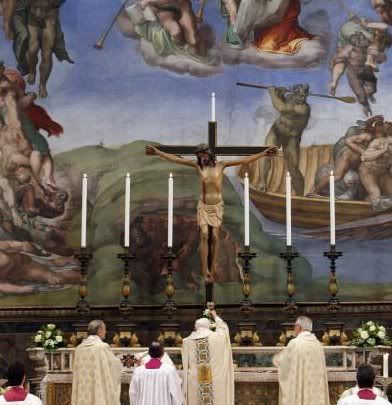
13 January 2007, Baptism of the Lord at the Sistine Chapel
Facing East in important because "...The priest is above all a servant of others, and he must continually work at being a sign pointing to Christ, a docile instrument in the Lord's hands. This is seen particularly in his humility in leading the liturgical assembly, in obedience to the rite, uniting himself to it in mind and heart, and avoiding anything that might give the impression of an inordinate emphasis on his own personality. I encourage the clergy always to see their Eucharistic ministry as a humble service offered to Christ and his Church. The priesthood, as Saint Augustine said, is amoris officium, it is the office of the good shepherd, who offers his life for his sheep." Sacramentum Caritatis #23.
Labels: Photos, Traditionalism
Low Mass Photos
 Here are the- long overdued- photos of the first Low Mass that was offered on the side altar of our Lady of Lourdes in the 4th quarter of last year at St. Joseph's Church. The celebrant was Rev. Fr. John Mary Chin, OCD. Enjoy!
 The insertion of the Sacred Relics of Ss. Felicity and Perpetua.
 The Altar as it ought to be- clothed in 3 piece of fine linen.
 View of the Altar from the Gospel Side
 The Offering of the Host
 The Offering of the Chalice
 For This IS My Body- The Elevation
 Benedicat Vos- The Final Blessing
Labels: Liturgy, Photos, Traditionalism
Tenebrae 2008
 I was blessed to attend the first Tenebrae Service in 40 years. The offices of Matins and Lauds were beautifully chanted by the talented members of the St. Gregory the Great Schola.
For those who do not know what the Tenebrae is, here's some information I extracrted from Extraordinary From Singapore's blog: The Tenebrae is "the office which the clergy and the faithful say on Wednesday, Thursday, and Friday of this week, accompanied by the lamentations of the Prophet Jeremias, and other ceremonies. The word Tenebrae means darkness, and represents the prayers formerly said in the dark hours of the morning. In the Tenebrae the Church mourns the passion and death of, Jesus, and urges her children to return to God; she therefore makes use of those mournful words of Jeremias: 'Jerusalem! Jerusalem, be converted to the Lord, thy God!' " More information here.
Below are some of the photos I took with my new 7.2 megapixels Sony Cybershot DSC-H5. Enjoy!
 The Chapel 5 minutes before the Service.
 The Entrance Procession.
 The 15 candles; as you can see first has already been extinguished.
 The chanting of the lamentations of Jeremias.
 The female faithful veiled.
 The female faithful veiled.
Labels: Divine Office/Liturgy of the Hours, Liturgy, Photos, Tenebrae, Traditionalism
Tuesday, March 25, 2008
Thou Art Present!
In the Liturgy, we see that Christ is present as both priest and victim. He is present as priest in the person of the celebrant and victim, in the Eucharistic species. This has been affirmed by the council of Trent; "For, it is one and the same Victim, the same one now offering by the ministry of the priests as He who then offered Himself on the Cross, the manner of offering alone being different" (Denzinger-Schonmetzer 1743).
Over the course of the last 30 odd years, we have been seeing a decline in the believe in the Real Presence of Jesus in the Eucharist. What has contributed to this? Here are some of my findings/ideas:
- Christ's Sacramental Presence devalued; put on par with Christ's presence in the Scriptures.
- The idea that the common priesthood is more important becasue it makes Christ spiritually present.
- Genuflections which show adoration to Christ has been reduced significently; down to 3 from the original 14.
- Revised Offertory; "the bread of life", "spiritual drink".
- The Eucharist often being refered to in relation to the congregation and not in itself.
- The current GIRM makes no mention of the Real Presence. The word "bread" is used almost throughout the GIRM.
- The Celebrant is encouraged to receive the Body of Christ reverently without making a genuflection.
- The purification of fingers have been suppressed.
- The keeping of the thumb and finger joined as a sign of respect for the Sacred Particles from the consecration has been suppressed.
- Over usage of laity in the distribution of communion.
- Communion standing and on hand.
- The turning of the House of God into a entertainment center where audio-visual projectors screen advertisments, video clips, etc...
- The use of wine glasses in place of chaices and stainless steel bowls in place of gold-plated metal ware.
Labels: Communion, Eucharist, GIRM, Traditionalism
Sunday, January 6, 2008
Tridentine Mass in Singapore!
Enjoy!
I can't figure how to get the film upright... Apologies.
Labels: Extraordinary Form Singapore, Liturgy, Music, News, Traditionalism, Video
Friday, January 4, 2008
Liturgical Unity
Forty Years after the Council
It is a sad symptom of what is “certainly a genuine crisis” (Pope John Paul II, Veritatis Splendor, 5) in the current life of the Church that those faithful who are rightfully attached to the Classical Rite or the Tridentine Liturgy have been accused of being ‘divisive’ or of ‘causing disunity’ in virtue of their attachment. The Holy Father has condemned such unjust treatment of traditional Catholics and even asked forgiveness for, “The at times partial, one-sided and erroneous application of the directives of the Second Vatican Council, (which) may have caused scandal and disturbance concerning the interpretation of the doctrine and the veneration due to (the Sacrament of the Holy Eucharist)” (Dominicae Cenae, III.12).
Of Fidelity & Sensibility
There is indeed a great threat to unity in the Church. It comes, however, from those who reject and disobey the apostolic tradition, NOT from those who UPHOLD it: “The criterion that assures unity amid the diversity of liturgical traditions is fidelity to apostolic Tradition” (Catechism of the Catholic Church, 1209). Therefore, it is the actions of the majority of the mainstream Catholic Church clergy and laity who have deviated from fidelity to apostolic tradition that has plunged the Church into the crisis that all of us now face. Only if wisdom that respected history, tradition, and sensitivity had prevailed, there would have been a far better result and less division.
Our Birthright
Futhermore, many young people have not heard of this rite of Mass that Pope Urban VII proclaimed as, ''the most beautiful thing this side of heaven". Perhaps, the Church could also take this opportunity to expose young Catholics to the rite of worship of our ancient Catholic religion and give them a sense of pride in their faith.
Only with pride and zeal for their faith, will young people step out to serve in the various ministries on their own accord. The traditional Mass is the birth right of all Roman Catholics around the world.
Community of Believers
The Second Vatican II Council refered to the Church as a Community, I'm sure that there are the older generation of Catholics who miss the old rite of Mass too, we have to be charitable and ensure that they do not feel left out. As a community of believers, we have to take into consideration all our brothers and sisters and not only our own intentions.
It is also interesting to note that over the past few years, an increasing number of young people have shown keen interest in the Tridentine Liturgy. The Church needs to be ready to supply the needs of the young people who will eventually be the supporting pillars of the Church.
Directions
Where are we headed I can't say... but perhaps the spirit of our late Holy Father, John Paul II is with us, continuing to bring about the 'new evangelization' he once called for. An evangelization not only to the Pagans and Protestants but amongst Catholics as well- an immersation of the rich liturgical ceremonies and customs of our One, Holy, Catholic, and Apostolic Church. Amen.
Labels: Evangelism, Holy Father, Liturgy, Second Vatican Council, Summorum Pontificum, Traditionalism
Saturday, September 1, 2007
Organic Growth
A clip from the lecture "The Classical Roman Rite and the Renewal of the Liturgy," by Msgr. Michael Schmitz of the Institute of Christ the King Sovereign Priest. The transcript may be found here.
You may also be interested in Msgr. M. Schmitz's article on The Gateway to Eternity as well. In this article, Msgr. Schmitz dicusses the Classical Roman Rite and its meaning for the Church.
Labels: Institute of Christ the King, Litugical Abuse, Liturgy, Traditionalism, Video
Sunday, August 12, 2007
We Have a Valid Cause!
K.I.S.S. (Keeping it short and simple)
- Catholics who embrace the traditions of the Church are not doing so out of nostalgia. We embrace tradition because WE ARE PROUD OF TRADITION.
- We know that the Church wasn't perfect before the council; there was laxity in catechisis, the understanding of what the Mass really was was deteriorating, and Catholicism was more of a religion than a relationship with Jesus Christ, etc... We are not "imaginging a glorious past". We believe that education and orthodoxy is the solution to those problems and that of today's.
- Latin. Click here.
- Any orthodox Catholic would know that the Holy Sacrifice of the Roman Catholic Mass is one of the major battlegrounds in the war against the principalities of Hell. With heresy everywhere and with orthodoxy being purged and persecuted, anyone striving for holiness in this secularized world will definately feel some sense of militancy. We are not trying to fight for identity, we are fighting for liturgical and doctrinal sanity.
- How can non-believers identify the Son of Man in the Church- the Sacrament of God's love- when so many Catholics themselves cannot seem to identify the birth, life, passion, death and resurrection of Jesus in the Mass?
- Lack of faith? Harsh words, Fr. Mowe... Catholics who long for the traditional Mass are sharing the same faith as that of countless Saints who were sanctified by the "bells and smells of the Baroque liturgy"; their service to God's people was the natural biproduct of that form of sanctity.
Labels: Latin, Liturgy, Reply, Thoughts, Traditionalism
Friday, August 3, 2007
Oakland priest Michael Wiener has been celebrating the Traditional Latin Mass since 1999
Incense, bells, mysterious words intoned in an ancient language, congregation and priest moving gracefully in unison as they perform a 1,500-year-old ritual -- that was the old-style Catholic Mass.
But when the Vatican decided to open up the Mass to improvisation in 1965, guitars replaced Gregorian chants, local languages replaced Latin, the priest faced the congregation rather than the altar and the entire Mass was simplified; a priest no longer made the traditional complicated series of scripted gestures during the Mass, nor did he wear elaborate old-style vestments.
Some appreciated the more down-to-earth feel of the new Mass. Others mourned the loss of the mystical, magical ancient Mass. Priests whose congregations wanted to celebrate the old-style Mass -- also referred to as the Tridentine Mass -- had to receive permission from a bishop to do so, until Pope Benedict XVI removed that restriction earlier this month.
Father Michael Wiener is a priest of the Institute of Christ the King Sovereign Priest in Oakland who has been celebrating the Traditional Latin Mass since he became a priest in 1999. I spoke with Father Wiener by phone about new- and old-style masses, the media coverage of Pope Benedict's restoration of the Latin Mass and the accompanying outrage over the reinstatement of a prayer asking God to convert the Jewish people.
Some of my Catholic friends who grew up with the traditional-style Latin Mass are quite passionate about it. They say it feels very special and powerful. What about it appeals to you?
It's mystical. It expresses very well the character of our faith, which at its center is a mystery -- the mystery of the incarnation of God.
Some people describe the Latin Mass as "bells and smells." That expression is somewhat belittling, but it's also accurate because the Latin Mass appeals to all of our senses in a powerful way. The Catholic faith is like that; it takes in the whole human being. It's not just something intellectual, something you read about in books.
Let's talk more about the traditional Latin Mass. For a long time you needed to get permission from a bishop before you could perform the Tridentine Mass. Why?
I believe there was a desire to unify the church's practice to the greatest possible extent by introducing the changed liturgy [new Mass] to the greatest number of faithful. But there have always been large numbers of people who have continued to celebrate [the traditional way].
Do you think the pope's announcement came as a surprise to many people?
No, I don't think so. The pope's predecessor, Pope John Paul II, had published two documents that urge wider practice of the Tridentine Mass. Pope Benedict's announcement was in line with this, it was a natural progression for the pope to end the requirement to get a bishop's permission before celebrating the Mass. It's a very happy progression for the faithful who are attached to the traditional rite.
Do you prefer celebrating the Tridentine Mass?
I do! I'm very much in love with this "Mass of all Ages" because it links us to the history of man, so to say. For many, many centuries, this Mass was celebrated and sanctified people, and it has brought about many saints.
All this has developed slowly and organically over the centuries, and is therefore a joy to celebrate. In German we'd describe it as "Gesamtkunstwerk," which means a piece of art that expresses an idea in a very complete way. In the Latin Mass, the priest, who is representing Jesus Christ, is enacting the mysteries of our salvation. The rite itself is full with history and many significant gestures and prayers. It's not only the language the Mass is said in, it's also what the priest does at the altar. Every gesture has meaning.
What are some of the gestures?
The kissing of the altar, making the signs of the cross many times, bowing your head, putting your hands on the altar or folding them on your breast. There are many, many gestures that in their sequence and in their completeness express the beauty of our religion. These gestures express the reverence, the worship, the respect and the awe of the priest in the moment of celebration. And I think the whole composition is very beautiful.
Pope Benedict said he was authorizing parish priests to celebrate the old Tridentine rite if a "stable group of faithful" requests it. Why does one need a stable group?
Celebrating this Mass requires a great deal of organization. It takes a major effort even to make the celebration possible. To ask a parish priest to do that is excessive if nobody is really interested within the parish. I think for this reason, and for maintaining harmony within the parishes, it's very important that the Mass be conducted in an orderly way.
There's been some concern in posts on Catholic blogs that offering old and new Masses may polarize parishes into two camps. Does that worry you?
Not really. I'm in the happy position to be in a parish which has both rites -- St. Margaret Mary in Oakland has the new Mass, the so-called Reformed Mass of Paul VI, and the traditional Mass. And it's worked out well.
Do you think some priests are intimidated or worried about performing this complex ceremony? Or are most priests trained to do it even though it hasn't been performed widely for 40 years?
I can imagine some priests hesitate to practice this Mass, although many are trained to do it in traditional religious communities. I have had several requests, in the Bay Area, from priests who would like to learn to celebrate the Mass.
Many of the news reports since the Pope's statement have focused on the fact that the Tridentine Mass includes a prayer asking for the conversion of the Jews. How do you feel about that issue, and the way it's been represented in the media?
I don't think there is much to say. That prayer is part of the Good Friday liturgy. And the church doesn't ask for the light of faith only for the Jewish people, there are also other people mentioned. So I don't see any problem with that. I don't think it's bad to ask God for his grace and for help and for assistance.
Pope Benedict also recently said that other Christian traditions are not as valid as Catholicism. It just seems to me that the Pope might be thinking now is the time to bring people of all faiths together, rather than emphasize their differences. How do you feel about that?
This is, I would say, simply a repetition of the teaching of the church expressed in many documents and on many occasions. It's nothing new. It's the teaching of the universal importance of our salvation. I don't have any problems with that. The pope certainly tries everything to integrate all groups and individuals in a discussion and in his pastoral care, as pope. He receives everybody, and everything, and talks about these things, but he is also a teacher.
How do you bring people of all faiths together if you are saying that other faiths aren't as valid as Catholicism?
Well, that's a church policy question. I'm not the person who can really speak to that. But very briefly, it's the old and well-known position of the Catholic Church that the full truth of Jesus Christ is present in the Catholic Church. That does not mean that part of Christ and Christ's teachings are not present in other religious groups. But it means that in the Catholic Church alone there is the complete full truth of Jesus Christ.
I don't mean to badger you about this, but these issues have been widely talked about in the news lately, in the coverage of the Latin Mass. So I wanted to get your side of the story ...
I'm used to explaining to people, if they ask me, that when we say that the Catholic Church has the full truth, that does not mean that nobody can be saved outside of the Catholic Church. It means that Christ is our universal savior, and the Catholic Church is, so to say, the most safe ship with which we can cross the Atlantic or the ocean. The Catholic Church is the best equipped ship to reach eternity.
This is not news. People wake up every 10 years, when the church underlines these things again, but these are not new ideas. And other religions do the same thing. You will never hear from a member of the Islamic community that his faith is only relative. You will never hear from an Orthodox Jew that his faith is only relative. That would not be a faith -- - it would be something that is, perhaps, nice on a personal level, but not universally important. The Catholic Church has the name Catholic Church because it's universal. "Catholic" means concerning everybody and all. So, there is nothing new about this teaching.
Labels: Holy Father, Institute of Christ the King, Latin, Liturgy, Summorum Pontificum, Traditionalism
Thursday, July 26, 2007
Headmaster Dolores Umbridge

While watching Harry Potter and the Order of the Phoenix yesterday afternoon at the new Grand Cathay Cinema *alone*, one pharse from Dolores Umbridge struck me. It goes as follows... "Progress for the sake of progess should be frowned upon. We should preserve what ought to be preserved and perfect what can be perfected". It appears that these words from Hogwarts's adjunct headmaster applies fairly well to the Church today.
If it ain't broke, don't fix it.
At least with H.H. Benedict XVI's reign, the Church is begaining to feel more Romish. Only time will tell what the Good Lord has in store for us. Let us continue to pray for an end to abuses in the Sacred Liturgy and for unity in the Church!
Labels: Holy Father, Litugical Abuse, Liturgy, Movies, Rants/Musings/Thoughts, Traditionalism
Wednesday, June 20, 2007
Liberalization of Latin Mass Imminent

The Papal "Motu Proprio" for the liberalization of the Latin Mass according to the Tridentine rite of Saint Pius V is ready, is about to be translated into several languages and will be published right before the departure of Benedict XVI for the summer vacation. [Rorate note: The Pope's vacation this summer will take place in a small villa of the property of the Diocese of Treviso, in the tiny hamlet of Lorenzago di Cadore, Province of Belluno, in the Veneto region, in the July 9-27 period.]
The text has already been signed by the Pontiff, who has even written a long exaplanatory letter, of a theological character, "addressed to all the Bishops of the world", as it can be read in its introduction, "so that they may receive this document with serenity and patience".
The Pope thus asks to the Bishops, to the clergy, and to the faithful a serene mood in the acceptance of the "Motu Proprio", which will be presented in a Press Conference by Cardinals Francis Arinze, Dario Castrillon Hoyos, and Julian Herranz.
The delay in the publication of the document seems to be related to strong oppositions from some sectors of the clergy (especially from the French Episcopal Conference).
Monsignor Nicola Bux (a personal friend of the Pope), a theologian and collaborator of the Congregation for the Doctrine of the Faith, declares: "You may write calmly [that] Pope Benedict XVI loves agreement and collaboration, and does not wish to decide everything on his own, which is why he has heard several and repeated opinions, but the Motu Proprio for the liberalization of the Latin Mass has been signed and its publication is imminent, I would say it is a matter of days."
The Tridentine Mass is completely celebrated in Latin, with the exception of a few words and sentences in Ancient Greek and in Hebrew; it is interspersed with long periods of silence, to allow the faithful to adequately meditate on the greatness of the Eucharistic mystery which they are called to assist. The faithful follow the liturgy reading the bilingual handmissal or leaflet, which carry, side by side with the Latin text, the integral translation of the actions in Italian or in the other national languages.
It is not only the use of the ecclesiastical and universal ("Catholic" means precisely universal) language which represents the sole standing difference between the Tridentine Mass and the modern one. The priest, differently than what takes place in the course of the new rite, turns his back to the faithful, as he celebrates turned to the tabernacle and the altar which constitutes the representation of Calvary; the image is that of the celebrant who guides the people.
Labels: Holy Father, Latin, Liturgy, News, Traditionalism
Friday, June 8, 2007
Why Latin?

To understand this we have to thrust ourselves into the Holy Sacrifice of the Mass. To enter the Celebration is to enter a sacred mystery. Latin is able to give the Mass a holistic sense of mystery. But, can't other vernacular languages acomplish that too? To answer that question we need to look at what worship and prayer is and how they work.
In his book, Prayer Primer, Rev. Fr. Thomas Bubay SM, talks about interpersonal union and intimacy in prayer. In chapter 9, Fr. Bubay explains that contemplation is, "a real awareness of God, desiring and loving Him...", "... there are no words." If we read the teachings of St. Thomas Aquinas and some modern writers such as Evelyn Underhill and Dom John Chapman OSB, we will see that God does not communicate to the human soul by words or via our intellect.
Would you believe me if I told you that worship that remains at our human intellectual level is not really prayer? Such worship is only a mutual admiration and exhortation.
Genuine Catholic worship is "a deep absorption, so deep that any distractions cease for five to ten minutes," Fr. Thomas Bubay SM. Genuine prayer also lifts us out of ourselves and to the incomprehensible and indescribable God.
The forms, words and actions we use are only symbols that help us raise our heats, minds, and soul to God. Prayer is a matter of the heart, not head. Even when we pray using words, etc... the real business should be taking place in the heart; at a much deeper level.
Fr. Thomas Bubay SM, explains in Prayer Primer, the traditional three kinds of prayer: vocal, meditation, and comtemplation. Vocal prayer is one that remains mainly in the head. Meditation, exercises the intellect- one thinks profoundly about God. Contemplation (which will be emphasised here) is a purely wordless prayer. In contemplation, "we open our hearts and minds to God, " says Fr. Francis Randolph (author of Know Him in the Breaking of the Bread), we "are aware of His presence and are longing for His love; there are no conscious or intellectual thoughts. Words mean very little; glancing lightly off the surface."
Contemplative souls find it very difficult to keep attention on the the intellectual surface of the mind and still be able to pray. A contemplative person will be frustrated if natural contemplation is forced to remain at a level of vocal prayer. He or she will feel as if he/she has not prayed at all.
This is the problem with the new Mass in the vernacular. Contemplatives are agonized when they are 'forced' to keep in touch with the words; they are 'prevented' from praying. In a Latin Mass, which is mostly silent, a contemplative will find attendence and assistance more relaxing. They wouldn't mind going to Mass again!
The problem is that many people have not read St. Thomas or Abbot Chapman, thus, they feel guilty attending a Latin Mass. Fr. Francis Randolph explains that in his experience of many years of confessions, he has been convinced that a very large proportion of people are natural contemplatives but do not know it.
The Catholic Church is a diverse community of believers, we need to respect the mode of prayer of others and cannot insist that one form of prayer is better that the other. Let the vocal/intellectual Catholic worship in the Vernacular Mass, let the contemplative Catholic worship on the Latin Mass. His Holiness, the late Pope John Paul II, the Great, acknowledged that mistake that the Church by forcing the changes the Mass without any sensitivity to the feelings of the people. In a letter to the Bishops on Holy Thursday, 1980, Pope John Paul II wrote, "I would like to ask forgiveness- in my own name and of all of you, venerable brothers in the Episcopate- for everything which, for whatever reason, through whatever human weaknessimpatience, or negligence, and also through the times at partial, one-sided and erroneous application of the directives of the Second Vatican Council, may have caused scandal and disturbance concerning the interpretation of doctrine and the verneration due to this great Sacrament." and also “to all those Catholic faithful who feel attached to some previous liturgical and disciplinary forms of the Latin tradition, I wish to manifest my will to facilitate their ecclesial communion by means of the necessary measures to guarantee respect for their rightful aspirations. In this matter I ask support of the Bishops and of all those engaged in the pastoral ministry in the Church.", "By virtue of my Apostolic Authority I Decree... Respect must everywhere be shown for the feelings of this who are attached to the Latin liturgical tradition, by a wide and generous application of the directives already issued some time ago by the Apostolic See, for the use of the Roman Missal... of 1962.” Pope John Paul II, Ecclesia Dei.
An International Language
This is an entire different consideration. In our globalized, modern world, we need a language that does not carry any political implications with it. Three of the world's most dominant languages are French, English and Spanish. But to use these languages isn't fair to those who speak minority languages and tongues. For this, Latin has the advantage. No one race or political system can claim the language. Latin belongs to the world that has already gone by- the old world.
Our cosmopolitant world, filled with migrants, refugees, tourists, etc... the abolition of an international language is absolutely absurd! I don't think it is too late to repair the damage.
In Christo,
J-PDM
Acknowledgements/References:
Know Him in the Breaking of the Bread by Fr. Francis Randolph
Labels: Books, Languages, Latin, Liturgy, Novus Ordo, Prayer, Quote, Quotes, Thoughts, Traditionalism
Tuesday, May 22, 2007
Latvia & Liturgical Reform
In a recent 'Catholic World Report' interview (extracts from which appear below), Cardinal Janis Pujats, Archbishop of Riga, Latvia, explained how the post-Vatican II changes in the liturgy were implemented in his country without the range of problems which have been encountered in other parts of the Catholic world.
(AD2000, May 2003) By 1972 we had the new Missal in Latvia, but it was not yet translated. We celebrated the Novus Ordo in Latin, so the people did not notice much change.
So we were already celebrating the liturgy according to the Roman Missal, in Latin. We read the Gospel in Latvian. If the entire Mass had been in Latvian, then maybe we would have faced towards the people. But we used Latin, and we couldn't "talk to them" in Latin, so there was no particular point in turning towards the people.
Consequently we did things in a step-by-step fashion. First we did the Mass in Latin. Then we started to translate the Lectionary. Finally we translated the whole Missal. When we were done with this, we turned towards the people for the Liturgy of the Word.
In the Liturgy of the Word, we are talking to the people, and they are listening to the Word of God. So at that point we should face them. But even today, after we are finished "talking to the people," we turn to the altar to prepare the elements and so forth.
We are not hurrying to turn around the altars. When we build smaller churches, even today, I do not have the altar built out from the wall. This is not a particularly significant matter. The Pope himself turns his back to the people in his own chapel.
The Second Vatican Council does not require facing the people, and I was fully aware of this. According to Vatican II, if it is better to face the people, then the priest should do so; if not, one can celebrate Mass in the old manner.
I think that the criticism [by Western liturgists of Eastern Europe's 'backwardness' in liturgical renewal, e.g., priests celebrating Mass with their backs to the people] is unjustified. These critics see only the outward appearance; they see that the altar has not been turned around. They ignore all the rest of the liturgical reform to focus on this one thing. But liturgical reform touches all of the Mass. There is a very significant difference between the texts of the Tridentine Missal and the texts that are given to us now.
I do not look upon it as an offence to anyone that the priest stands facing the altar to celebrate Mass, even in the Novus Ordo. The Pope knows that we are not in any particular rush to change this. When you make such a change, some people like it and some people don't, so you stir up controversy.
Our liturgical reforms, on the other hand, have been going on for 30 years, and the people do not feel any negative effects from the changes, because of the way they have been introduced and administered. The people are at peace.
Extremes
What happened outside Latvia happened rather quickly. The Council was not to blame, but the liturgical translators were at fault. The Council was not radical, but when the liturgists began formulating changes, all sorts of extremes emerged. They confused people's minds by what they did.
And we can even boast that our slow liturgical reform preserved old traditions that have been lost elsewhere. I am thinking in particular of the tabernacle in the centre of the altar, with the Eucharist as the centre of the church rather than somewhere off to the side, and the confessionals.
I myself have seen (I will not say in what country) the tabernacle on the floor - in a corner on the floor. That is no way to honour Jesus in the Blessed Sacrament. I have seen an altar that has been erected from left-over logs: big split logs, placed cross-wise; and across these planks they put a tablecloth to cover it. And this was not in a mission territory, but in a traditionally Catholic country! So the fact that the Eucharist is still in the centre is the primary thing which we have preserved.
The other important thing that we preserved is the confessional. We have not taken them out of the churches, and therefore we have not shortened the lines of penitents. The confessionals are a sort of visible advertisement. The people are already in lines, and so someone who is fearful of going to confession will look at the lines and see that they are very long, and that makes it easier for him to get in line. No one whose faith is shaky will go by himself, and ask individually to see a priest for confession; instead, he will not go to confession at all.
Of course there is another big problem: that in many countries people have the idea that confession is no longer necessary. The result is that today, in many places, few people go to confess their sins, but they all go to Communion. I look on this as the biggest mistake that "reformers" have made. When they lifted the people onto their feet it was apparent to me that it would take two generations to get them back on their knees. And to get them to go to confess their sins, to make their individual confessions, after they have tossed that practice aside - I doubt that can be done.
But with us, individual confession has remained the norm. We have never given general absolution - that is to say, absolution for the whole congregation. That practice is for extreme circumstances, and with the obligation for individual confession later. It is better to go straight to the individual confession. If the people are already accustomed to that practice, then it is better to keep it. We look upon that as a matter in which Westerners can learn something from us.
Labels: Confession, Eucharist, Holy Father, Latin, Liturgy, News, Novus Ordo, Roman Missal, Second Vatican Council, Traditionalism, Viewpoints
Wednesday, May 16, 2007
The Pre-Conciliar Church: Dull?

What is our identity as latin-rite Roman Catholic?
Now, the Oxford Wordpower dictionary defines the word 'dull' as "not interesting or exciting; boring" How could the Church have been dull?
Our forefathers never asked themselves, "Why am I Catholic?" Why? Becasue, the Church before the Second Vatican Council tended to identify Catholicism and Roman Catholicism. Those who were raised before the council were given a strong sense of identity. Holy Mother Church in her wisdom nutured and sustained her flock with maternal affection. Catholicism was more than a religion, it was an entire system of thinking, behaving, and even feeling. You could leave the Church but you'd not be able to change the way you ha been taught to view the world, God and even religion.
Today, many young Catholics do not have nearly the sense of identity their parents did. Ask the youth in your parish and they wouldn't be able to tell you the difference between their Church and the ones their Protestant friends go to. Thus, the question, "Why am I Catholic" will inevitably return during their adulthood. Many will face dilemas; some may question the authority, others may leave the Church, et cetera...
Ask any Catholic what the Mass is, many will tell you that it is just a celebration. Indeed it is, however, isn't it more than a celebration? The Mass is also a sacrifice. When the sacrificial nature of the Mass is taken away, we'd be like any other (liturgical) protestant church. Though in principle today's Catholics have greater access to the inner meaning of the Mass, do we understand the spiritual benefits that can be obtained behind it?
Where has the Catholic- or rather 'latin rite Roman Catholic'- identity gone to?
Surely, there must have been something interesting or exciting that gave rise to such a strong sense of Catholic identity...
Was it the (Latin) Tridentine Masses? Maybe, but I think no one should wish to return to the days when many priests seemed to rush through a mumbled Mass as quickly as possible (I'm thinking of Low Masses here), the congregation indeed present mainly as spectators.
Was is something else? Could it have been the fact that the pre-concilar view of the Church focused more on the importance of a universal rite of Mass and eccelesial tradition rather than on local churches, on other rites and other ecclesial traditions (Eastern Catholic Churches)?
Frankly I do not have an answer as to whether or not the pre-conciliar Church was dull or exciting.
But, judging a tree by it's fruits, it coundn't have been dull: Just count the number of ordinary Catholics who became saints, the large number of priestly and religious vocations, the strong weekly Mass attendance, the long confession lines, the unchanging Latin Mass and Sacraments, the statues of saints and our Blessed Mother, clerical clothing and religious dress, ridgid adherence to Church's laws, unswerving obedience to the Pope, et cetera... The is evidence that there must have been something 'exciting' that kept the Church alive and robust.
Then again, Christ's guarantee that the gates of hell will not prevail against his Church does not, as has often been pointed out, mean that the Church necessarily flourishes in ways which can be discerned with the human eye.
The answer will be left open. Let me know what you think. Do read 'Notes of the True Church: Extra Ecclesiam Nulla Salus', a possible significant contribution to Catholic identity.
I apologise for the parts in which I rant.
Perhaps there is a need for a Thrid Vatican Council?
"Conservative Catholic ask why the Chruch is giving up so much so fast,
liberal Catholics ask why the Church is not changing faster" Joseph Martos
Deo Juvante
Feast of the Ascension of the Lord 2007
Acknowledgements/Bibliography:
Rev. Fr. Richard Rohr, Joseph Martos, James Hitchcock
Labels: Catholic Belief, Second Vatican Council, Thoughts, Traditionalism
Monday, May 7, 2007
Integrity of the Psalms
Those of you who pray the Divine Office (Liturgy of the Hours) probably learned that the Office is a systematic praying of the Psalms in union with the whole Church. What they probably didn't tell you, if you are using an edition revised since Vatican II, is that you're not actually praying all the Psalms. Some of the Psalms have been edited to remove unpleasant parts, and two Psalms have been dropped altogether.
Tim Cravens, who is a blogger and apparently a bishop in the Independent Catholic movement, is quite right when he argues for maintaining the integrity of the Psalms in the Liturgy of the Hours.
Labels: Divine Office/Liturgy of the Hours, Prayer, Psalter, Second Vatican Council, Traditionalism
Saturday, May 5, 2007
Another example of the sea of change
"Father Bob Griffith, the Episcopal blogger of hypersync, comments on a phenomenon we have noticed, too, in Roman Catholicism: the younger generations are interested in the old liturgical forms and the old liturgical music that prevailed before the unfortunate experiments of recent decades." Rev. Fr. Jim Tucker. "Give Me That Old-Time Religion!"
I've been saying for the last 10 years or so that there is a generational sea change being realized in North America, particularly in the U.S. To be honest, I'm less familiar with what is going on in Canada, but I suspect something similar.
I've said over and over again that the tail end of Generation X, Gen Y, and whatever is next, are of a different temperament when it comes to what resonates with them within the whole Christian melee and spirituality more generally. The Social Gospel of liberal, mainline Protestantism is dead (not to suggest working with the poor is dead, however!), the Baby-Boomer Seeker church experience has run its course, the liberal "god is dead" or perhaps "Process" theological perspectives have shown themselves to be not very satisfying to most people. The younger generations, so demographers and generationalists suggest, seek after something more solid and ancient (read, not trendy), something that restores a sense of mystery, and something that is respectful and none-condescending - unlike much of what passes for "modern" church.
I've said before that I hear more and more from younger people that they prefer the language of Rite I (Elizabethan English), they like the more formal liturgies, that they find resonances with contemplative and monastic-like spiritual experiences.
Now, I know that what I hear does not represent all young people and there are those who want absolutely nothing to do with High Church liturgy, old sounding English, or contemplative quiet. That's fine and good, but on the whole, there is a difference between our parents’ generation and the younger generations. I find that older people in the Church (the 1928 Prayer Book generation) and the young seem to have much more in common then the big group in the middle that now controls the Church. Funny, how that works. But, it is a good thing that within The Episcopal Church, and Anglicanism at least as it has been traditionally practiced, there is an allowance for the flourishing of different forms to meet the differing needs of various peoples.
I've also found that young people tend to want to be challenged to think and seek, but not told what to think or do by "authorities." They respect the authorities generally, but want them to help them seek and find rather than to indoctrinate them. No easy believe-ism for these folks!
Groups that do challenge, that take seriously the young people's wants and desires and NEEDS, that provide a way to the faith that shows seriousness and respect, are growing. Those that pander to political and social whims are not. I believe we will shortly witness a migration out of the neo-conservative political and social "Culture War" churches.
So, I found it interesting today when I took two young seminarians to lunch. One is 23 (or 22, I don't remember) and will probably be our seminarian this fall. The other is a young married guy. A lot of our conversation revolved around the Church, the young, what is happening, and what the future may hold. I listened, mostly (at least I think I listened, mostly).
These are smart guys. They go to General. They talked about their class and the attitudes and desires of their classmates. They even talked about an obvious difference between themselves and the "1960's hold-overs" that reign right now in the Church. "If the church can survive past the baby-boomer generation, there might be hope," from a rector friend of theirs who is a baby-boomer but recognizes both the good his generation has enabled and the baby they threw out with the bathwater.
I look at what is happening among the Emergent Church crowd (See the Episcopal/Lutheran Church of the Apostles in Seattle, Washington). Anyone who does not recognize the sea change either doesn't want to acknowledge what is happening or is truly blind. Again, not all are going to like High Church liturgy, etc., but there is a fundamental change nevertheless.
These two guys said there is even a semi-secret group at General that is regularly saying the Rosary. The Oxford Tradition of General is not dead, despite the 1960's "reformers" who want it to be so. How frustrating it must been for these folks whose life work has been to remake the Church into something else (what, I don't know), only to see young people raising the hands in front of them saying, "NO!" The "reformers" are now "The Man," and they are experiencing the rebellion of the youngsters and they don't know what to do with it (after all, aren't they the ones who are supposed to cast down tradition and authority and institutions?). Their work for naught, perhaps. Who knows...
One guy talked about his wife at Yale. An Episcopal Church in Newhaven has a regular chanted, candlelit Compline and the sanctuary is packed with young people. The rector doesn't know what to do - totally surprised by the result. I'm not.
Today, in the New York Times, an article entitled "Monks Who Play Punk," about a relatively new Roman Catholic monastic order in the Bronx.
"Upstairs, a 100 or more young people lingered in the quiet, candle-lighted sanctuary after an hour of prayer and song in front of the Eucharist. Brother Columba Jordan strummed his guitar and sang in a soft voice.... Two friars with heads bowed sat on either side of the alter, listening to the confessions of men and women waiting patiently in line."
This is New York City, folks. I see this kind of thing all over the place! And, then, there is also Revolution Church, which gets at the same thing in a very different way.
"The monthly holy hour of prayer and song and ensuing music festival are part of an event called Catholic Underground..." [By the way, some of the monks have a Funk and Punk band, complete with long beards and gray, hooded habits.] "...the creation of the Franciscan Friars of the Renewal, a religious order founded two decades ago this year in the Melrose section of the Bronx. Members own no personal possessions and beg even for their food. Nevertheless, the order's 10 friars are bursting with new recruits at a moment when many Roman Catholic religious orders are struggling simply to maintain their current numbers."
"Yet despite the simplicity of the order's lifestyle, the Fr4iars of the Renewal see their message as one othat has a powerful appeal to young people in the 21st century.
'We don't advertise, we don't promise you glow-in-the-dark Frisbees, none of that," said the Rev. Bernard Murphy, the order's head. 'Young people are idealistic, and so we live in a community that lives a high ideal.'"
"'The millennial generation is a spiritual generation,' said Brother Paul Bednarczyk, of the vocation conference. 'I think they are searching for meaning in their life, and I think they are looking to do something that is going to have an impact on the world.'"
In the article, as it ends, the are a couple comments made by people who the order ministers to. We read comments like, "When you're running on an empty tank, they're pretty much there to fill up the tank;" or this from a women who lost hear let when she had an encounter with a fire truck, "Ever since I starting coming here, I feel better about myself. I want to live again. Everything I eat here is spiritual."
Interesting, ah?
I'm afraid a good many people in The Episcopal Church (and within many churches!) still don't get it. Not only do they not get it, they actively try to keep their heads in the sand. As a seminary friend of mine used to say, "I can't wait until this generation of leaders in the Church retires. Then maybe we can get back to being the Church." I understand the point and count-point between all generations. There is always idealism among the young and a reaction to their parent's generation. This is nothing new. Yet, I still say there is as much of a profound change in this generation and the Boomers as we saw between the War II generation and the Boomers. We shall see what happens.
Labels: Links, Protestants, Sociology, Traditionalism
Monday, March 5, 2007
The Mass Matters
Celebrated beautifully and reverently. By Una Voce in Poland. Notice that the Priests ascends the pulpit during his homily. According to Catholic 'mystic' Maria Simma, the Holy Souls in Purgatory tell her that the reason why priests are no longer highly respected and have diminished control/authority over their flock is becuase of the abandonment of the pulpit.
This video only shows the Mass of the Catechumens up to the Homily.
Labels: Liturgy, Traditionalism, Video

Subscribe to Posts [Atom]


