Saturday, March 29, 2008
The Spirit Of A Believing Welcome
This may be wise according to the world's standards, but it does not represent the fullness of true Christian charity. Real giving always entails vulnerability. Christian charity, as modeled by the early Church in the 1st reading is based on the promise that the goods of this world come as gifts to be used wisely for the benefit of all, especially the poor and needy among us. Few of us are ever going to voluntarily give everything away; when we do give, however, may we give with the generosity of Christ which knows no limits.
Our giving also should not only be one in cash or kind, but also one in faith. A giving of our faith, a proclamation of our belief, a declaration of the spiritual truth we hold near and dear is sometimes what someone needs, more that money or help in any other form. Our Gospel text shows us Thomas in just that light. From refusing to open up his heart to accept, one meeting with the risen Jesus and he proclamed the highest form of faith that can be declared: "My Lord and my God!"
His believing welcome, as it were, of Jesus' risen presence among His disciples opened Thomas up to new and greater possibilities. His encounter with Jesus began to prepare him for the mission the Lord had in store for him. Jesus was in fact, taking Thomas out of the "tomb of doubt" that had enslaved him for so long. The Resurrection encounter gave Thomas the boldness to declare his faith, a faith he would one day gladly suffer martyrdom for.
Yet, what has all this in store for us? What practical application can we draw from the 1st reading and the Gospel passages of this Sunday's Mass? Possibly it is calling us to sit down in the presence of the risen Jesus and see just how generous, welcoming and faithful our Lenten preparation has made us. Have we given willingly during Charities Week? have we sacrifice some comfort for the sake of our felow Catholics?
Has our Easter celebration been one big faith proclamation? We will only be able to give like the early Church and profess our faith like Thomas once we allow the ever powerful Ressurection presence of Jesus to encounter us, challenge us, transform us and invite us to live fully as a child of the Light and a child of the Resurrection. Amen.
Teach us O Lord, to give without counting the cost & let us always boldly proclaim our faith in You, as our only Lord and God. Amen.
Fraternity of Mater Dolorosa
Labels: Easter, Sacred Scripture, Spirituality, Sunday Reading Reflections (A)


Thursday, January 24, 2008
The Conversation of St. Paul (25/01)
will guard my pledge until the day of judgement" Introit.
Lectionary:
Class: 2nd Class (Feast)
1st Reading: Acts of the Apostles 9:1-22 (Lord, what will you have me do?)
Gospel: Mk 16:15-18 (Go out to the whole world; proclaim the Good News.)
+ Saul of Tarsus was full of hatred for Jesus and his disciples. From a bitter persecutor he became an ardent apsotle and irresistible preacher of the Gospel. A Roman citizen and a student of Gamaliel, he was well grounded in the doctrine of the school of the Pharisees. He also had a part to play in the martyrdom of St. Stephen.
Scripture tells us that while he was on the road to Damascus during or about the year 34 A.D., he has a vision of the Risen Christ. That single event would change his life forever. The Risen Lord whose memory he tried to erase through his persecutions, opened his mind to the truth of the Christian faith. Our Lord also called Paul to follow Him as His disciple. From that day onwards, Paul dedicated his entire life to the mission of the Gospel, and to follow and serve the Christ who has personally chosen him as His apostle.
Paul was one of those who were present at the Fisr Council of Jeruselem. Through his influence, the council agreed that the old Jewish laws like circumcision were no longer had binding force on the new converts from paganism.
Paul was a man who refused compromise. He was a dedicated person who was capable of pursuing any ideals without first counting the cost. As christians, we are called to be witnesses. The word witness is derived from the greek word that means matryrs. Hence, as Christians, we are called to testify to the Gospel even to the point of death; not counting the cost whatsoever.
In order to suceed in being ardent servents of Christ, we need to pray for the grace of self-abandonment. Self-abandonment is a complete submission to Christ, His precepts, His Church, and His will. Many saints like St. Therese, the Little Flower were given this grace to surrender their desires and bind themselves entirely to God as revealed in the person of Jesus Christ. In self-abandonment, we leave behind all the concerns of the world and live a radical life for Jesus Christ. A life that is one for Him and won for Him.
Can we be like St. Paul? Can we receive the grace to abandon everything for the expansion of God's Kindgom here on earth? Yes. If we follow the footsteps of St. Paul; for the only thing that mattered to him was God.
Paul preached Christ as the one and only Saviour. A Saviour not only for the Jews but the Gentiles as well. Follwoing the one whom he loved so greatly meant that Paul had to walk in His- Christ's- footsteps. It was not easy for Christ's journey was one of ceaseless hard work, exhaustion, suffering, poverty, and close encounters with death. We read in his epsitles, that Paul, instead of giving up, embraced these sufferings a a means to help him grow into the image of Christ. In Galations, he tells us that as baptised Christians, we need to crucify our old self to Christ and be a new person rediating and reflecting Chirst.
How can we powerfully radiate and reflect our Lord? Through the Eucharist. We become what we eat. Christ's sacramental presence dwells in us through our reception of His Holy Body and Blood at Holy Communion during the celebration of the Holy Sacrifice of the Mass. Our bodies become the tabernacle of the King of Kings and the Lord of Lords. Do we receive Him with the love, humility, and reverence as our Blessed Mother did?
For only if we did, would be then be able to experience the power of God's grace.
If we take a look at Paul once more, we would see that he never failed to glorify the Lord for his conversation and his ministry. Because God knew the saintly man Paul would become- just as he knows every thought and desire in our minds and hearts-, it did not matter that He- God- would deliever His gift of vocation to Paul even when he was battling against the infant Church of Christ.
We see that Paul never forgot his calling as he constantly associated his apostolic mission with His encounter with the Risen Chirst. In like manner, priests and religious should not forget their calling to be servents of the Lord as well. Remembering the call of our First Love will never fail to remind priests and religious of their particular call to save souls. Canon law adequetely expresses this in s.1725, "the salvation of souls is the highest law".
With his calling in mind, Paul zealously ran all through Asia Minor, Greece, Rome and even Spain. Paul is probably the only one who is fit to say, "I have fought the good fight. I have finished the race, I have kept the faith. From now on is reserved for me the crown of righteouness, which the Lord, the righteous judge, will give me on that Day". Does that mean we, whose lives are nowhere near that of St. Paul will be able to enjoy the beatific light? No... Paul goes on to say "not only to me but also to all who have longed for His appearing" (2 Tim 1:7-8).
It is fitting that the Feast of the Conversion of St. Paul should coincide with the Week of Prayer for Christian Unity. Unity has not yet been restored. Christ founded only one Church. St. Paul tells us that we must be "making every effort to maintain the unity of the Spirit in the bond of peace. There is ONE body and ONE spirit, just as you were called to the ONE hope of your calling, ONE Lord, ONE faith, ONE baptism, ONE God and Father of all, who is above all and through all and in all" (Eph 4:3-6).
It is sad that the ONE Church of Christ has been divided through the sinful nature of man; through pride, aggrogance, and disobedience. The Decree on Ecumenism No. 1 by the Second Vatican Council affirms clearly and firmly that such a division "contridicts the will of Christ, scandalizes the world, and damages that most holy cause, the preaching of the Gospel to every creature".
Hence, it is the task and duty of the Roman Catholic Church- the one true Church- to continue Paul's mission of restoring unity.
It is easier said than done. Ecumenism is a very difficult undertaking. We have to be careful in ensuring that faith and the plan of God for the AUTHENTIC salvation of mankind is not watered down. This task, entrusted to the one and only Church of Christ is beyond all our human enregies and abilities. Therefore, let us beseech the intercession of St. Paul the Apostle for the unity of all Christians into the one fold of Jesus Christ. Amen +.
Labels: Christian Unity, Ecumenism, Liturgical Calendar, Saints, Spirituality
Friday, January 11, 2008
Baptism of the Lord (A)
Lectionary:
1st Reading: Is 42:1-4, 6-7
Gradual: Ps 29:1-2, 3-4, 3, 9-10 R/ Ps 11(b)
2nd Reading: Acts 10:34-38
Gospel: Mt 3:13-17
This is My Son, Listen to Him
Water as a sacramental. Water would never have been a sacramental should Jesus not have been baptised. By His baptism, He sanctified the water, hence now, water becomes for us a tool of purification for our souls.
In the book of Genesis we see the Church been metaphorically depicted as the ark carrying on board all sorts of creatures and rising above the waters that were commanded to wash the world of it's impurities and sins. Today, we as Catholics from all walks of life find ourselves in the ark- the Church who dispenses the waters of baptism to enable us rise to new life. How can we voyage as a community if we do not love the Church- our vessel? We need to love the Chruch- as Cardinal Rhode appropriately put it to the Jesuits during their recent international gathering. Our love is displayed through obedience and humility. All our efforts will come to naught if we fail to find ourselves on board the true ark of salvation.
Voice from Heaven- This is truly as sign of what a sacrament is. An outward sign of an inward grace. Here we see the voice from Heaven as the outward sign setting Jesus before the people as the promised one. The inward grace comes as the people receive faith in His Divine Mission.
Opening of Heaven- When we rise from our baptism, we see Heaven which had been closed since the fall, now opened by Jesus.
Labels: Sacred Scripture, Spirituality, Sunday Reading Reflections (A)
Saturday, December 15, 2007
Thrid Sunday of Advent (A)
1st Reading: Isaiah 35:1-6, 10 (God Himself is coming to save you)
Gradual: Psalm 145, R/ Isaiah 35:4
2nd Reading: James 5:7-10 (Do not lose heart, because the Lord’s coming will be soon)
Acclamation: Isaiah 61:1 or Luke 4:18
Gospel: Matthew 11:2-11 (Are you the one who is to come?)
Rejoice in the Lord always; again I say, rejoice. The Lord is near
Sent his disciples- No doubt whatsoever that Jesus was the Messiah; for this was the burden of his preaching at the Jordan. If this was the case, why did he send his disciples? He did so because many of them though had heard about the works of the Lord had not seen it for themselves and were not fully assured. Therefore in order to confirm their faith John sent them directly. Already knowing the intentions of John the Baptist, Jesus answers the question indirectly by referring to His works. Thus, confirming the faith of the disciples and the testimony of John.
How strong is our faith? When we send ourselves before the Altar of Sacrifice to receive the Body and Blood our Jesus in the Eucharist, are we fully convicted of His presence hidden under the veil of the sacrament or are we still asking questions?
Are you the one who is to come- This is a plain question showing what John wanted, that is the knowledge of Christ as the Redeemer. He did not ask for any proof or sign; in his final inquiry, we see a declaration that our Lord’s simple assertion was enough to command unconditional belief in Him.
Is our faith ready? Do we still ask questions, or signs, or proofs? “Blessed are those who have not yet seen but believe”. St. Peter J. Eymard once said that “tomorrow will be too late”. How true. We do not know the hour or the day of the Lord’s coming- not the end of the world, but rather death; our own end. When the time comes are we ready to meet Him with our unconditional believe that “He is the Christ, the Son of the Living God”? St. Peter Julian Eymard’s reminder is probably founded on the warning given by the prophet Malachi. He tells us, “who will be able to endure when the day comes? Who will be able to survive when He appears? He will like a strong soap, like a fire that purifies metal…” On that day, the Lord will appear as judge and “testify at once… against all who do not respect (Mal 3:5)” Him.
Go back and tell- If we look at Luke’s account in 7:21 we see that it was “at that VERY time” when the messengers were corresponding with Him that “He cured many people of their diseases, He cast out evil spirits & restored sight to the blind”.
When we see the works of the Lord, do we “go back and tell” our loved ones, friends, co-workers about the power and mercies of our great Lord and Savior? Are we being a testimony to His greatness?
Does not lose faith- Also translated to scandalize or offended. Why would Jesus say this? Why would people be scandalized, offended or lose faith because of His good works? To understand this we need to look at the Book of the Prophet Isaiah who foretold Jesus way of life to be characterized by “poverty and lowliness, suffering and death”. Jesus had to say this because the Jews had expected the messiah to come in pomp and power instead of humility and poverty; which by the way was a great hindrance to their faith.
Is humility and suffering a hindrance to OUR faith today as it was in the time of the Jews? Today’s society focuses much on the individual, on power, control, wealth, et cetera. We need to learn from John’s joyful reception of the Lord into his own life so that in time of adversity, or even in the face of the secular world, we may receive the consolation of having that joy.
Conclusion- The later part of the Gospel which discusses about John’s greatness is something that gives us an opportunity to reflect upon. John entered the world in a state of grace, growing daily in grace and virtue.
We came into the world in the state of original sin, BUT by the holy waters of baptism, this sin has been taken away and replaced by sanctifying grace. Have we lost this grace through mortal sin? When was the last time we made satisfaction for it through the Sacrament of Penance? To paraphrase the cry of the Baptist, turn away from thoughtlessness and forgetfulness of God to piety and fear of God! To be holy and godly Catholics, we need to try to prevent sin. This is what Jesus meant when he proclaimed that “the least in the Kingdom of Heaven is greater than he is” even though no one greater than him has ever been seen.
Is it possible to live holy and godly lives in a culture of sin and death? In the Second Reading, James advises us how to go about living holy and godly lives for the Lord in expectation and anticipation of His return. It is important to note that patience is an important virtue that we need to adopt in our lives because no one knows the exact hour the Lord is coming. It is with patience that we can, like the Baptist, persevere in the knowledge that Jesus is the Redeemer and that He WILL come to gather us back to Himself. Amen.
Labels: Sacred Scripture, Spirituality, Sunday Reading Reflections (A)
Thursday, December 13, 2007
Death and Advent
 There is something about this month of November that urges silent reflection. All of nature is quiet and asleep. The color of life as seen in trees, blooming meadows and fields—is all gone. The landscape is gray and brown—or perhaps even covered in white! Holy Church, always in harmony with God's providence and creation, dedicates this month to praying for the dead. And how can we do so without thinking of our own life—and our own death—which is meant to free us from the bonds of earth and bring us into God's presence forever? Does not St. Francis say in his beautiful prayer, "it is in dying that we are born to eternal life"?
The thought of death is not, and must not be, a morbid thing. No. Correctly seen, this life of time, given by God, is only temporary and but the brief, passing trial that must bring us to eternity. Our Lord and His Saints teach us this incessantly.
These are good thoughts to lead us into the liturgical season of Advent. For in this season of penitential, yet joyful anticipation, the Church continues these thoughts, as She presents for our reflection the coming of Christ Our Lord, not only in time, but also at the end of time. So is it not good to think about our own place in God's providential plan, and perhaps to examine our lives to see just how well we are corresponding to that loving plan? And when we do, let us practice that virtue so greatly needed in our time—hope. Remember what hope means? It is good to read the consoling definition of this essential virtue as we read it so long ago in the Catechism of the Catholic Church:
Hope is the virtue by which we firmly trust that God, Who is all-powerful and faithful to His promises, will in His mercy give us eternal happiness and the means to obtain it.
It is an infused theological virtue, received at Baptism together with sanctifying grace and having the possession of God as its primary object. It belongs to the will and makes a person desire eternal life, which is the heavenly vision of God, and gives one the confidence of receiving the grace necessary to reach heaven...
Our Holy Father, Pope Benedict XVI reminds us of this virtue in his new encyclical Spe Slavi. In the introduction, he explains that "according to the Christian faith, 'redemption' (or salvation) is not simply a given. Redemption is offered to us in the sense that we have been given hope, trustworthy hope, by virtue of which we can face our present: the present, even if it is arduous, can be lived and accepted if it leads towards a goal, if we can be sure of this goal, and if this goal is great enough to justify the effort of the journey. Now the question immediately arises: what sort of hope could ever justify the statement that, on the basis of that hope and simply because it exists, we are redeemed? And what sort of certainty is involved here?"
Faith is Hope. Our Holy Father also reminds us that "before turning our attention to these timely questions, we must listen a little more closely to the Bible's testimony on hope. “Hope”, in fact, is a key word in Biblical faith—so much so that in several passages the words “faith” and “hope” seem interchangeable".
Dear brothers and sisters in Chirst, the Season of Advent is THE season of hope. Hope in the one who was, who is and is to come. Amen.
Labels: Advent, Catechism of the Catholic Church, Death, Hope, Spirituality, Thoughts
Tuesday, October 16, 2007
St. Margaret Mary Alacoque

Readings:
First Reading: Ephesians 3:14-19
Responsorial: Psalm 22 R/ v.1
Acclamation: Matthew 11:25
Gospel: Matthew 11:25-30
Introduction
St. Margaret M. Alacoque was born at Verosvres, France in 1647 and entered the Order of the Visitation in 1671. Jesus appeared to her in numerous visions, displaying His Sacred Heart, sometimes burning as a furnace, and sometimes torn and bleeding on account of the coldness of the sins of men. In 1675 the great revelation was made to her that she, in union with Father de la Colombiere S.J., was to be the chief instrument for instituting the Feast of the Sacred Heart and for the spreading of the devotion throughout the world. St. Margaret M. Alacoque died on October 17, 1690.
“It is the ingratitude of men which has hurt Me more than all the suffering I underwent during My Passion. If only they would make some return for My love, I should think but little of all I have done for them and would wish, were it possible, to suffer still more. But the sole return they make for all My eagerness to do them good is to reject Me and treat Me with coldness. Do thou at least console Me by supplying for their ingratitude as far as thou art able.”
Contemplation
The contemplation of the benefits of Jesus towards us ought to become the source of our practical devotion to the Sacred Heart. For only love alone can respond to love. In his appearance to St. Margaret, Jesus 'complains' of the lack of love in return for His love: "Behold this heart that has so loved men and which receives from them only ingratitude." Thus, it is clear that it is only by love, by the gift of the heart that we should respond to Christ Jesus. The suggested hymn for the feast of the Sacred Heart rightly expresses this by the following words, "Who will not love in return for the one Who loves him? Who being redeemed will not love His Redeemer?" Today we question our love for Jesus. Do we really love Him? Can we assuredly say that if we were on Calvary 2000 years ago, we would have embraced the cross on which hung our Lord?
“Behold this Heart, Which has loved men so much, that It has spared nothing, even to exhausting and consuming Itself, in order to testify to them Its love; and in return I receive from the greater number nothing but ingratitude by reason of their irreverence and sacrileges, and by the coldness and contempt which they show Me in this Sacrament of Love. But what I feel most keenly is that it is hearts which are consecrated to Me, that treat Me thus...”
Love of God
The love we offer God if to be perfect must bear a double character. A great English abbot once explained that there is "first of all, affective love; it consists in the different feelings which move in the heart towards a person loved." I would believe such feelings to include: admiration, joy, and thanksgiving. The other character, he explained is praise. Such a love as described above gives birth the praise. For we want to praise the works of His hands, the blessings He has bestowed upon us, our loved ones, and for the simple fact that He and only He is God.
“My Divine Heart so ardently loves men that, unable to contain within itself any longer the flames of its burning love, it needs must spread them with your assistance, and thus it will show itself that all men may be enriched with its most precious treasures...”
Our Response
Today, we rejoice in the perfections if the Heart of Jesus, we celebrate it's beauties, and grandeurs, we delight in the magnificence of it's benefits. And in union with St. Peter Julian Eymard, the Eucharistic saint of reparation, we unite ourselves with all the sufferings of Jesus as we draw closer to His Most Sacred Heart. Amen.
Oremus
O Lord Jesus Christ, Who to the blessed virgin Margeret Mary did in a wondorous manner reveal the unsearchable riches of Your Heart: by her merits grant, that loving You after her example in all things and above all things, we may obtain an abode in Your Heart for evermore. Amen. St. Margeret Mary, pray for us.
Related Link: The Sacred Heart of Jesus.
Labels: Links, Prayer, Saints, Spirituality
Friday, September 28, 2007
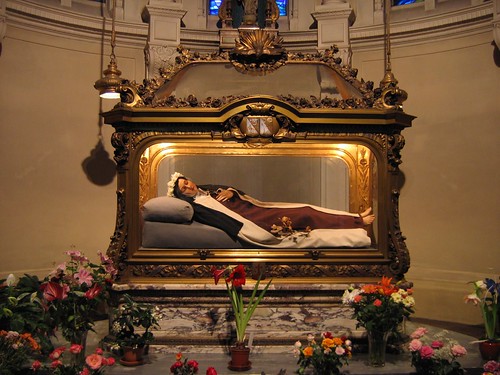
Saint Thérèse de Lisieux
 Introduction
 Mary Frances Therese Martin was born at Alencon, France. Her parents were pious individuals who were well endowed with a confortable amount of the goods of the world. Despite all the material possessions, she entered the Carmelite Convent in Lisieux at the age of fifteen; she would spent the next nine years of her life in holiness and humility before expiring at the age of twenty four.
Her ambition to love God perfectly and to conquer souls for Jesus was fulfilled when she died in the odor of sanctity aftering wisphering her very own words of commendation, "My Lord, my God... I love Thee!"
Self-Abandonment
The spirit of self-abandonment that St. Thérèse possesed led her to holiness. What is self-abandonment? Can we abandon ourselves in today's context?
Holy abandonment is one of the purestforms of love; it is the height of love; it is loveing giving to God, unreservedly, our whole being, with all it's energies, activities, concerns, etc... in order that we may be a true and worthy sacrifice to God.
The for example the lives of the monks or cloistered nuns. What makes them holy? What drives them to their lives apart from the world? To do nothing else but pray, meditate, and work? Because these prayer warriors have been given a special grace, the grace of self-abandonment. When the spirit of self-abandonment to God animates a monk's/nun's whole life, that monk/nun has attained holiness.
Holiness
Being holy does not make one a living saint. Being holy also does not mean that a person does not sin; he may sin less, but sins nonetheless. Being holy is substantially the conformity of all our being to God; it is amen said by the whole being and it's faculties to all the rights of God. This is somewhat like Mary's fiat, a fiat full of love, whereby the person responds unceasingly and unfalteringly, to the Divine Will of God.
Our Amen, our Fiat
Dear friends, if we want to do God's Will, if we want to be holy, we must say amen with St. Thérèse and utter our fiat with her. In other words, we need to offer our lives to God like she did. Together with her, let us shout a resounding amen and humble offer our fiat in a spirit of perfect donation whereby the whole being to God is the spirit of abandonment, a spirit which is the sum total of faith, confidence and love. Amen.
Let us pray. O Lord, who had said, "Unless you become as little children you shall not enter the Kingdom of Heaven". Grant we beseech you, so to follow in humility and simplicity of heart the footsteps of Saint Thérèse, the Virgin, that we may obtain everlasting rewards. Saint Thérèse, pray for us. Amen.
Labels: Prayer, Saints, Spirituality
Sunday, July 22, 2007
That's the Spirit!
Fr. Teo made a comment after a screeing of the video, 'Euchristic Miracles' in the rectory's meeting room this afternoon. "When I was training as a priest, we did everything in Latin. Now there's the vernacular; we cannot acheive the same with the vernacular. The latin (Eucharistic Hymns) can really make you cry!" said a the teary rector.
Spirituality appeals to the imagination that is why the modern rites are so lack the feeling that the latin hymns of old conjure up; giving one the concept of a timeless sacred space that connects one with other believers through the ages.
"Holiness is what we are seeking to attain and our thoughts drawn into at the Holy Sacrifice of the Mass. It is not a party or any worldly celebration, so why should our music sound worldly? We don't want to get distracted by music that has worldly connotations, so we should avoid instruments and musical selections that would have those connotations," PBXI
We must bring the sacred to the secular,
not put the secular into the sacred.
Labels: Liturgy, Music, Quote, Quotes, Spirituality, Video
Friday, July 13, 2007
Preparation for Holy Mass
 O LORD Jesus Christ, King of everlasting glory,
(PROFESSION)
Thou art the Triune God in whom my mind and heart remain fixed, firm and rooted immovably for evermore.
(DIRECT YOUR INTENTION)
Behold I desire to come to Thee this day to commemorate all Thy sufferings, and receive Thy Body and Blood in the heavenly Sacrament.
(INVOCATION)
Send down upon this sacrifice your Holy Spirit. May He declare the Bread we eat to be the Body of Christ,and the cup we drink to be the blood of Christ. May He fill me with His presence to make me worthy of Thy promises, and obtain for me life everlasting.
(PETITIONS)
(OFFERING)
Gracious God after whom my hart and soul panteths,In union with the Immaculate Heart of Mary, I offer this Mass for: STATE YOUR INTENTION(s). Grant that the insurmountable graces hidden behind this Eucharistic Celebration be directed to these intentions; as Thou willest.
(THANKSGIVING)
(PRAYER OF CONFIDENCE)
Grant that I may one day see Thee face to face. May nothing in life, or death separate me from Thee. AMEN.
A compilation from the prayers of St. Augustine and St. Thomas Aquinas. Includes my own compositions.
Labels: Liturgy, Photos, Prayer, Spirituality
Sunday, July 8, 2007
The Examen

The Examen comes in two parts: The General Examen and the Particular Examen.
The general examen, as the name implies, is a general overview of my moral behavior during the past day. We must assume that our conduct has been both praiseworthy and blameworthy. We should also look forward to the next day and prepare ourselves beforehand on how we should do God's will in the immediate future that awaits us.
The particular examen of conscience follows logically on the general examen. Some are more prone to pride than to lust. Some are more prone to anger than to greed. Some are more prone to envy than to sloth. In fact, each one of us changes from time to time in what failure of our moral conduct is dominant, depending on the circumstances and persons who enter our lives.
The particular examen concentrates on coping with the predominant moral weakness of our own personality.
Below is a prayer I composed. For each of the five wounds of Christ and the elevation of the Cross, we reflect on our obligations to God and to Man. The title Heart to God, Hand to Man- the motto of the Salvation Army- reminds us that our actions must always be two pronged.
HEART TO GOD, HAND TO MAN
(For Private Use)
1) General Examen: Thanksgiving, Failures, Resolutions
[Thank the Lord for the graces He has given to us, whether pleasant or painful]
BEHOLD, O kind and most sweet Jesus, I cast myself upon my knees in Thy sight. With deep affection and grief of soul, I ponder within myself and mentally contemplate Thy crucifixion.
For the times I have failed to keep thy passion in my mind and ignored the cries of my neighbors, Lord Jesus, thy hallowed crown was pierced.
For the times I failed to lift my hands to thee in worship and refused to lend assistance to my neighbors, Lord Jesus, thy sacred palms were pierced.
For the times I failed to love thee and my neighbors as thou hast commanded, Lord Jesus, thy precious side was opened.
For the times I failed to live the life of Christian poverty- by being tempted by material possessions- and not coming to the aid of my neighbors, Lord Jesus, thy linen was stripped away.
For the times I walked away from thee or from my needy neighbors, Lord Jesus, thy anointed feet were pierced.
For the times I failed to live a life of humility, Lord Jesus, thou went through the greatest mock trial and was crucified on Calvary
I BESEECH Thee therefore, my sweet Lord Jesus Christ to grant that thy Passion may be to me a power by which I may be strengthened, protected, and defended. May thy five sacred wounds be to me food and drink, by which I may be nourished, inebriated, and overjoyed. May the sprinkling of Thy Blood be to me the washing of my sins. May Thy death prove to me life eternal. Thy cross be to me an everlasting glory. In these be my refreshment, my joy, my preservation, and sweetness of heart. Who livest and reignest for ever and ever. Amen.
2) Particular Examem: Predominant Tendencies
[Examine predominant moral weaknesses in your own personality]
3) Concluding: Supplication for Grace and Salvation
[ALL: Confeitor* V/ Miseratur**… R/ Amen]
*Note: Any one of the formulas (Rites A, B, C i-viii) given in the Missal may be used.
Some Formularies
- Rite A
ALL: I confess to Almighty God,
and to you here present
that I have sinned through my own fault
[Strike Beast Thrice]
in my thoughts and in my words,
in what I have done,
and in what I have failed to do;
and I ask blessed Mary, ever virgin,
all the angels and saints,
and you, here present,
to pray for me to the Lord our God.
-OR-
ALL: I confess to Almighty God,
o blessed Mary ever virgin,
to blessed Michael the archangel,
to blessed John the Baptist,
to the holy apostles Peter and Paul,
to all the saints and to you, brethren,
that I have sinned exceedingly in thought, word and deed:
[Strike Beast Thrice]
through my fault, through my fault, through my own most grievous fault.
Therefore I beseech blessed Mary ever Virgin,
blessed Michael the archangel,
blessed John the Baptist,
the holy apostles Peter and Paul,
all the saints and you, brethren,
to pray for me to the Lord our God.
(Missal of Bl. John XXIII)
V/ May Almighty God have mercy on me,
forgive me my sins,
and bring me to everlasting life. R/ Amen.
- Rite C(i)
C/ You were sent to heal the contrite:
P/ Kyrie eleison
C/ You came to call sinners:
P/ Christe eleison
C/ You plead for us at the right hand of the Father:
P/ Kyrie eleison
V/ May Almighty God have mercy on me,
forgive me my sins,
and bring me to everlasting life. R/ Amen.
- Anglican Use Liturgy, Rite 1 (With Ecclesiatical Approvial)
ALL: Almighty God, Father of our Lord Jesus Christ, maker of all things, judge of all men: We acknowledge and bewail our manifold sins and wickedness, which we from time to time most grievously have committed, by thought, word, and deed, against thy divine Majesty, provoking most justly thy wrath and indignation against us. We do earnestly repent, and are heartily sorry for these our misdoings; the remebrance of them is greivous unto us, the burden of them is intolerable. Have mercy upon us, have mercy upon us, most merciful Father; for thy Son our Lord Jesus Christ's sake, forgive us all that is past; and grant that we may ever hereafter serve and please thee in newness of life, to the honor and glory of thy Name; through Jesus Christ our Lord. Amen.
V/ May Almighty God, our heavenly Father, who of his great mercy hath promised forgiveness of sins to all those who with hearty repentance and true faith turn to him, have mercy upon us, pardon and deliver us from all our sins, confirm and strengthen us in all goodness, and bring us to everlasting life; through Jesus Christ our Lord. R/ Amen.
References
- Roman Catholic Daily Missal, Angelus Press
[Texts: "Behold" & "I Beseech"] - The Sunday Missal, Collins Liturgical Press
[Formularies] - The Book of Divine Worship (Anglican Use Liturgy)
- Examen of Conscience
[Definations/Introduction]
Labels: Divine Office/Liturgy of the Hours, Examen, Prayer, Spirituality
Saturday, June 2, 2007
The Blessed Trinity

we will give glory to Him, because He hath shown His mercy to us.
O Lord, our Lord, how wonderful is Thy name in all the earth!"
Tob 12:6, Ps 8:2
We have celebrated the arrival of the Holy Spirit at Pentecost last Sunday. Today, Holy Mother Church celebrates the Feast of the Holy Trinity. The Trinity is the fundamental dogma of our Faith.
"This time is well chosen," says St. Rupert, "for, immediately after the descent of this Divine Spirit, began the preaching and belief and Baptism and confession in the Name of the Father, the Son and the Holy Spirit."
At today's vigil Mass- which I served- at St. Joseph's, PM, Father Rector Michael Teo gave an illustrous homily on the the "Godhead" (Fr. Teo likes to refer to the Trinity as the Godhead three-in-one).
The Father, Son & Holy Sprit is the Trinity. To the non-believer, the concept of the Trinity may be polytheistic.
The word "trinity" is a term used to denote the Christian doctrine that God exists as a unity of three distinct persons: Father, Son, and Holy Spirit. The Trinity is NOT POLYTHEISTIC. The Trinity is a strict monotheism; there exists in all the universe a single being known as God who is self-existent and unchangeable (Isaiah 43:10; 44:6,8). Therefore, it is important to note that the doctrine of the trinity is not polytheistic as some of its critics proclaim. Trinitarianism is MONOTHEISTIC by definition and those who claim it is polytheistic may demonstrate a lack of understanding of what it really is.
The Trinity:
- God is three persons
- Each person is divine
- There is only one God
Each- Father, Son, or Holy Spirit- is fully divine in nature, but each is not the totality of the Trinity. In other words, the Father is not the same person as the Son who is not the same person as the Holy Spirit who is not the same person as the Father. Each is divine, yet there are not three gods, but one God.
We can refer to the three different 'entities' of the Trinity as either: Person or Subsistence. The word "subsistence" means something that has a real existence. The word "person" denotes individuality and self awareness. (The latter has become a more common term to describe the Trinity.)
The Doctrine on the Trinity is difficult to grasp as the Trinity is a mystery that cannot be fathomed by the human intellect. The fact that it is a mystery is an argument for its truth.
Sacred Scripture is the self revelation of an infinite God. Therefore, we are bound to encounter concepts which are difficult to understand; especially when dealing with an incomprehensible God who exists in all places at all times.
"The Trinity cannot be understood by the human intellect, it is not a mathematical problem, even if it were, we could not solve it mathematically. The Trinity is a mystery. St. Thomas, one of the great Doctors of the Church tells us that 'we cannot walk around the mystery, we need to enter the mystery- enter into a relationship with God.' " Rev. Fr. Michael Teo, in his homily today.
 Oremus:
O ALMIGHTY and everlasting God, Who has enabled Thy servants, in confessiong the true Faith, to acknowledge the glory of the eternal Trinity, and in the power of Majesty to adore Its Unity: we beseech Thee, that be steadfastness in the same Faith, we ever be defended against all adversity. Through our Lord. Amen.
In the Holy Trinity,
J-PDM
The Most Holy Trinity 2007
Labels: Apologetics, Catholic Belief, Quote, Spirituality, Trinity
Monday, May 14, 2007
Christ's Representative
Because the image of the priest has been thoroughly disparaged in popular culture, many Catholic parents have a distorted opinion of the clergy. We have seen how systematic campaigns, orchestrated by certain groups with the help of the mass media, ridicule religious conviction in general and often strive to portray the Catholic priest as an absurd or irrelevant individual. Perhaps this explains why each year we witness the loss of promising vocations due to the inexplicable resistance of some parents who oppose their sons’ priestly calling.
Therefore, it is important that you promote an appreciation for the priest as Christ’s representative among men. Thankfully, there already exists among numerous families a sincere respect for the priest and an esteem for the priestly vocation. Frequently, I meet young couples who express their hope of having one or more of their sons become priests. Yet this work must continue if we wish to offset the attacks which the priesthood suffers today attacks which damage the Church by tearing down the image of the priest in the eyes of the Catholic faithful.
Labels: Priesthood, Spirituality, Vocations
Monday, March 5, 2007
Our Lenten Worship: The Prayer of St Ephrem

O Lord, and Master of my life,
give me not the spirit of slothfulness, faint-heartedness,
lust of power, and vain talking;
but instead grant to me, Your servant, the spirit of integrity,
humility, patience and love;
O Lord and King, grant that I may see my own
faults, and not judge my brother,
for You are blessed unto the ages of ages. Amen.
The priest recites this prayer audibly, unlike most prayers offered aloud in our services. Customarily, we make prostrations after each clause, three in all. The prayer is repeated at virtually every service on the weekdays of Lent. We (or rather, the pious among us) say this prayer several times a day, wherever we happen to be.
The prayer begins with a reaffirmation of our acceptance of God as our Lord and Master over our entire life, all that we are, have and do:
"O Lord, and Master of my life"
At the same time, we come to Him acknowledging our sinfulness and the great sins to which all humanity is inclined as a result of our fallen state - sins that lead us to commit all others, in fact:
"the spirit of slothfulness, faint-heartedness, lust of power, and vain talking"
Slothfulness - i.e. laziness! The Christian life is an effort (which does not mean to say we cannot enjoy life). Christ has promised to give us joy, but joy - real joy - has nothing in common with laziness. Laziness steals our time and gives no joy, one discovers only one has done nothing. Exercise is a good cure for laziness - and Lent is a spiritual exercise.
Being faint-hearted is to ask "Why should we try? What for? We will only fail, so why make the effort?". It is a notion that we cannot accomplish anything. God does not demand success; God is always there to pick us up with His love when we fail.
Lust of power is not only something that characterizes military dictators and control freaks but it is also the foundation of "spiritual independence" to which it ultimately leads. The way of humility and obedience is based on our sense of "need" for God, our dependence on Him and the means He has placed at our disposal to achieve union with Him, by means of and in His Church.
Vain talking - the Spiritual Fathers of the Philokalia, the great teachers of the spiritual way rooted in the constant invocation of the Name of our Lord Jesus, take extra care to warn us of this sin! The harm done to individuals, families and communities by foolish words, often spoken in haste, is countless. Christ in the Gospels warned the people of His day who were very concerned with the sins committed by what went into the mouth that what comes OUT of the mouth is what should be guarded against.
All four of these sins represent the four corners, so to speak, of the fundamental "window" that leads us into sin and spiritual tragedy.
We also ask for specific virtues:
"the spirit of integrity, humility, patience and love"
As God's servants, we ask God to reflect in us His Grace through the virtues that run counter to the four vices we enumerated in the first verse.
Integrity is the virtue by which we recognise God's plan for us and do our best to live in accordance with that plan.
We often think of "humility" as the opposite to integrity. Genuine humility is not at all undignified - humility is freedom from illusion. Humility is being prudent. Humility is being clear-sighted. Humility is ultimately realizing that we are called to sanctification and Divinization in Christ, as He demonstrated on Mount Tabor.
Patience comes from the Latin "patient" - "to suffer". It also means not losing hope that God will answer us and keep His Promises to us, no matter what befalls us now. Suffering, in fact, far from being something to be shunned, is an experience that teaches us how truly dependent we are on God and His Mercy.
We ask for the gift of real, authentic love. Christian love is not a sentiment nor an emotion - it is an act of the will, a virtue. It is a gift of God's grace, but we must make the effort to exercise that gift of grace.
After praying for these 4 virtues, we make two more requests:
"grant that I may see my own faults, and not judge my brother"
We can only truly answer for our own sinfulness, for our own intentions. Only God may judge others. This is why we never say, in public prayer, "have mercy on us sinners" but only "have mercy on me a sinner".
The Bible asks us, "who are you that you should judge another man's servant? (Romans 14:4)" Each of us shall answer to the Lord; God forbid that we should judge each other. Christ warns us, "For with what judgment you judge, you will be judged! (Matthew 7:2)"
Instead of judging, let us pray to God to make us always merciful, as He is merciful to us.
Labels: Lent, Orthodox, Prayer, Spirituality
Giving and Commitment

(By Rev. Fr. Marcial Maciel, LC)
Look at Christ on the Cross and learn from him what it means truly to love. He did not redeem us with promises, feelings of compassion or desires to give himself, or with his high-sounding words; and he could have done so, since he was God. But, since he loved us and love is gift without limits, he willed to show us his love by loving us with concrete acts: becoming man, living and suffering our human condition, giving himself out of love for his Father and each one of us, obeying, forgiving, turning the other cheek, enduring terrible humiliations in silence, offering his back to the fury of the whip, opening his hands to be pierced ... out of love for me, to save me.
Otherwise, where else would the martyrs have found the courage to die with pardon on their lips and praising God if they did not have before them the words and example of Christ’s death? What would happen to the dying and the sick if in the midst of their suffering they could not clasp the crucifix in their hands? How could we fulfill God’s will in our daily lives, especially when it causes our hearts to bleed, if Christ in Gethsemane had preferred his will to his Father’s, without his It is consummated from the Cross (John 19:30)?
How easily we deceive ourselves thinking that we love God when in reality we take love for an emotion, a moment of psychological freedom or an occasional burst of generosity! There is so much egoism disguised as love! So when you want to know if you really and truly love, look at Christ crucified. If your love is like his, that is, total self-giving with concrete deeds, then your love is authentic, and you are real Christians. It might well be that you don’t have lots of feelings and emotions, that at times your love stands on the rock of a faith stripped of all human consolation, but it is love because there is giving and commitment.
Labels: Lent, Spirituality
Friday, March 2, 2007
An Eternal Paradox
 Christ’s Cross is an eternal paradox. A life brutally cut down in the fullness of maturity. A failed, naked and abandoned man, his life ebbing in the death rattle of a slow and horrible agony ... Everything about the Cross beckons us to the pit of despair; and yet there, precisely in the densest and bitterest darkness, Christ realizes the most luminous and meaningful act open to a man, offering himself to his Father and each one of us in an act of perfect love. Greater love has no man than this, that a man lay down his life for his friends (see John 15:13).
His executioners could nail his body to the wood, but they could not chain his freedom: No one takes my life from me, but I lay it down of my own accord (see John 10:18). Christ crucified is the freest man that ever lived; nothing and no one could stifle his heart nor stop him loving his Father and men. His love for me was stronger than death itself (see Canticles 8:6).
Such a death cannot be improvised. That last, heroic act of self-giving was the fulfillment of a Plan of salvation, the end result of a host of little acts of giving throughout his life. After Christ’s death there is no circumstance in our lives, no matter how painful or difficult it might seem, to which our love cannot give the value of redemption. We all carry our personal cross. For some this is only an instrument of suffering and the cause of perdition because they do not know how to love; for others, however, their cross is a cause of deliverance and happiness because they fix their gaze on Christ and offer themselves with him out of love: "Today you will be with me in Paradise" (see Luke 23:43). What really dehumanizes man is to bear a cross without Christ - to live, suffer and die without love.
Labels: Spirituality
Wednesday, February 21, 2007
Remember you are dust, and to dust you will return
 Here's a photo which I took this evening before Ash Wednesday Mass.
I burnt the last of previous year's palm leaves left behind by some members of the congregation.
Lent preparation for Lent begins today. It includes the three Sundays called respectively Septuagesima (50), Sexagesima (60), and Quinquagesima (70). They were so named because in the early days of Christianity many communities began the fast 50, 60 or 70 days before Easter. In order not to have to fast every day of the forty.
Today- Ash Wednesday- is the Wednesday after Quinquagesima. The name Ash Wednesday is derived from the imposition of Ashes upon the foreheads of the faithful. On this day- Ash Wednesday- the season of Lent commences; it is 46 days before Easter; thus the number of days is completed without the six Sundays, on which we do not fast.
During Lent the public life of Our Lord Jesus Christ is set before us, His previous fast, His Passion and death. The 40 days which intervene before the ascension represent the 40 days He spent on earth after His resurrection. (Traditionally, the 3 days before the Ascension are Rogation days; on these processions are held.)
This Lent let us obtain actual graces by performing good works, especially by prayer, fasting, and almsdeeds; and more especially by the use of the means of grace provided by the Church, by hearing Holy Mass and worthy reception of the sacraments.
God's grace cannot be obtained by our own good works alone, otherwise it would not be grace (Rom 11:6), yet these good works are necessary, for, as St. Augustine says, "God, Who created us without our co-opertation will need not save us without our co-operation." Not according to the works we have done but out of His mercy has God saved us (Tit 3:5). Graces are given to us by the Holy Ghost as He wills, with regard however to the preparation and co-operation of the individual (Trent 6,7). Hence it is that a man receives more actual grace as he is richer in good works. Some efficacious prayers include prayes to the Holy Ghost and to the Mother of God as we know that God gives the Holy Spirit to those who ask Him and that Mary is "full of grace", and "the dispenser of all graces." St. Alphonsus, founder of the Order of the Holy Redeemer reminds saying, "Let no one consider this last title extravagent, for the greatest of Saints have so spoken of her, and the Saints, as we know, were inspired by the Holy Ghost, the Spirit of truth."
Some other means of confering many graces include prayer to the Blessed Sacrament and the mortification of the senses. The latter (found in the conduct of the Apostles during the time preceeding Pentecost) is a good example of drawing down grace.
Have a Holy Lenten Season!
Copiosa apud eum redemptio,
Paul D. Molina
Ash Wednesday '07
Labels: Catholic Belief, Lent, Photos, Spirituality
Monday, February 19, 2007
Holy Father's Lenten Message 2007
“They shall look on Him whom they have pierced” (Jn 19:37)
Dear Brothers and Sisters!
“They shall look on Him whom they have pierced” (Jn 19:37). This is the biblical theme that this year guides our Lenten reflection. Lent is a favourable time to learn to stay with Mary and John, the beloved disciple, close to Him who on the Cross, consummated for all mankind the sacrifice of His life (cf. Jn 19:25). With a more fervent participation let us direct our gaze, therefore, in this time of penance and prayer, at Christ crucified who, dying on Calvary, revealed fully for us the love of God. In the Encyclical Deus caritas est, I dwelt upon this theme of love, highlighting its two fundamental forms: agape and eros.
God’s love: agape and eros
The term agape, which appears many times in the New Testament, indicates the self-giving love of one who looks exclusively for the good of the other. The word eros, on the other hand, denotes the love of one who desires to possess what he or she lacks and yearns for union with the beloved. The love with which God surrounds us is undoubtedly agape. Indeed, can man give to God some good that He does not already possess? All that the human creature is and has is divine gift. It is the creature then, who is in need of God in everything. But God’s love is also eros. In the Old Testament, the Creator of the universe manifests toward the people whom He has chosen as His own a predilection that transcends every human motivation. The prophet Hosea expresses this divine passion with daring images such as the love of a man for an adulterous woman (cf. 3:1-3). For his part, Ezekiel, speaking of God’s relationship with the people of Israel, is not afraid to use strong and passionate language (cf. 16:1-22). These biblical texts indicate that eros is part of God’s very heart: the Almighty awaits the “yes” of His creatures as a young bridegroom that of his bride. Unfortunately, from its very origins, mankind, seduced by the lies of the Evil One, rejected God’s love in the illusion of a self-sufficiency that is impossible (cf. Gn 3:1-7). Turning in on himself, Adam withdrew from that source of life who is God Himself, and became the first of “those who through fear of death were subject to lifelong bondage” (Heb 2:15). God, however, did not give up. On the contrary, man’s “no” was the decisive impulse that moved Him to manifest His love in all of its redeeming strength.
The Cross reveals the fullness of God’s love
It is in the mystery of the Cross that the overwhelming power of the heavenly Father’s mercy is revealed in all of its fullness. In order to win back the love of His creature, He accepted to pay a very high price: the blood of His only begotten Son. Death, which for the first Adam was an extreme sign of loneliness and powerlessness, was thus transformed in the supreme act of love and freedom of the new Adam. One could very well assert, therefore, together with Saint Maximus the Confessor, that Christ “died, if one could say so, divinely, because He died freely” (Ambigua, 91, 1956). On the Cross, God’s eros for us is made manifest. Eros is indeed – as Pseudo-Dionysius expresses it – that force “that does not allow the lover to remain in himself but moves him to become one with the beloved” (De divinis nominibus, IV, 13: PG 3, 712). Is there more “mad eros” (N. Cabasilas, Vita in Cristo, 648) than that which led the Son of God to make Himself one with us even to the point of suffering as His own the consequences of our offences?
“Him whom they have pierced”
Dear brothers and sisters, let us look at Christ pierced in the Cross! He is the unsurpassing revelation of God’s love, a love in which eros and agape, far from being opposed, enlighten each other. On the Cross, it is God Himself who begs the love of His creature: He is thirsty for the love of every one of us. The Apostle Thomas recognized Jesus as “Lord and God” when he put his hand into the wound of His side. Not surprisingly, many of the saints found in the Heart of Jesus the deepest expression of this mystery of love. One could rightly say that the revelation of God’s eros toward man is, in reality, the supreme expression of His agape. In all truth, only the love that unites the free gift of oneself with the impassioned desire for reciprocity instills a joy, which eases the heaviest of burdens. Jesus said: “When I am lifted up from the earth, I will draw all men to myself” (Jn 12:32). The response the Lord ardently desires of us is above all that we welcome His love and allow ourselves to be drawn to Him. Accepting His love, however, is not enough. We need to respond to such love and devote ourselves to communicating it to others. Christ “draws me to Himself” in order to unite Himself to me, so that I learn to love the brothers with His own love.
Blood and water
“They shall look on Him whom they have pierced.” Let us look with trust at the pierced side of Jesus from which flow “blood and water” (Jn 19:34)! The Fathers of the Church considered these elements as symbols of the sacraments of Baptism and the Eucharist. Through the water of Baptism, thanks to the action of the Holy Spirit, we are given access to the intimacy of Trinitarian love. In the Lenten journey, memorial of our Baptism, we are exhorted to come out of ourselves in order to open ourselves, in trustful abandonment, to the merciful embrace of the Father (cf. Saint John Chrysostom, Catecheses, 3,14ff). Blood, symbol of the love of the Good Shepherd, flows into us especially in the Eucharistic mystery: “The Eucharist draws us into Jesus’ act of self-oblation … we enter into the very dynamic of His self-giving” (Encyclical Deus caritas est, 13). Let us live Lent then, as a “Eucharistic” time in which, welcoming the love of Jesus, we learn to spread it around us with every word and deed. Contemplating “Him whom they have pierced” moves us in this way to open our hearts to others, recognizing the wounds inflicted upon the dignity of the human person; it moves us, in particular, to fight every form of contempt for life and human exploitation and to alleviate the tragedies of loneliness and abandonment of so many people. May Lent be for every Christian a renewed experience of God’s love given to us in Christ, a love that each day we, in turn, must “regive” to our neighbour, especially to the one who suffers most and is in need. Only in this way will we be able to participate fully in the joy of Easter. May Mary, Mother of Beautiful Love, guide us in this Lenten journey, a journey of authentic conversion to the love of Christ. I wish you, dear brothers and sisters, a fruitful Lenten journey, imparting with affection to all of you, a special Apostolic Blessing.
Labels: Holy Father, Homily, Lent, Spirituality
Wednesday, February 14, 2007
Do You Really Love Me?

" Then, Come To Me..."
"...Visit Me Before The Blessed Sacrament"
on earth. Do those things that will
lead you to eternal life.
WON'T YOU PLEASE?
Come to Me frequently before the
Blessed Sacrament, especailly,
when you are hurting with worry,
fear, anxiety and pain and suffering
of any kind.
Attend Mass and receive Holy Communion more frequently.
Pray more and say the rosary.
Get to know Me better so that I can
better help you carry your cross.
Labels: Announcements, Catholic Belief, Spirituality
Tuesday, February 13, 2007
His Apostle
(By Rev. Fr. Marcial Maciel)
"It hurts me to see the suffering people undergo because of injustice, abuse and lack of love. It hurts me to see that Christ does not reign in the hearts of people, to see the obstinacy so many people mount against him, to see their indifference when faced with his call."
"For me, being a priest means being an apostle, working ceaselessly for him, and fighting so that everyone knows and accepts him. I don’t care whatever kind of cross comes my way, or isn’t the priest another Christ?"
Labels: Priesthood, Quote, Spirituality, Vocation
Sunday, February 11, 2007
Pastoral Letter of Exhortation from Archbishop Nicholas Chia

The interior and religious character of penance neither excludes nor lessens in any way the external practice of this virtue. By divine law all the faithful are required to do penance. Even in biblical times we see people doing some form of penance as a sign of sorrow for their sin. It is indeed a religious, personal act which has as its aim, love and surrender to God. There is no lack of examples in Scriptures also of a social or collective awareness of sin.
Reaffirming this necessity, the church continues to seek - beyond fast and abstinence - new expressions of penance, more suitable for the times. Lent remains the pre-eminent Penitential season. All Fridays are days of penance because each Friday recalls the crucifixion of Our Lord. Ash Wednesday and Good Friday remain days of fast and abstinence.
Fasting means that the amount of food we eat is considerably reduced. All Christians from the age of 18 to the beginning of 60 are bound by the law of abstinence (C. 1252). However our penance cannot be restricted to refraining from meat on Fridays.
In order that we appreciate the meaning of penance more deeply, any of the following practices may also be adopted to fulfil the obligation of penance (on Fridays throughout the year unless they are solemnities):
1) By abstaining from meat and having simple meals;
2) By abstaining from alcoholic drink, smoking or some form of amusement;
3) By making the special effort involved in family prayer, taking part in the Mass, a visit to the Blessed Sacrament or a more attentive reading of the Bible, visiting the Blessed Sacrament or praying the Stations of the Cross;
4) By fasting from all food for a longer period than usual and perhaps by giving what is saved in this way to the needy at home and abroad; and
5) By making a special effort to spend time with or help somebody who is poor, sick, old or lonely.
The obligation to do penance every Friday remains an essential part of our Christian life. However, the manner we do it can take a different form every Friday. It is hoped that all the faithful of this region may make that sincere effort in memory of the Passion and Death of our Lord.
May this Lenten Season be a special time of grace for all of us. May we learn to die to ourselves so that we will rise with Christ at Easter!
Yours devotedly in Christ,
Archbishop Nicholas Chia
Labels: Catholic Belief, Lent, Open Letter, Spirituality

Subscribe to Posts [Atom]


