Thursday, January 24, 2008
The Conversation of St. Paul (25/01)
will guard my pledge until the day of judgement" Introit.
Lectionary:
Class: 2nd Class (Feast)
1st Reading: Acts of the Apostles 9:1-22 (Lord, what will you have me do?)
Gospel: Mk 16:15-18 (Go out to the whole world; proclaim the Good News.)
+ Saul of Tarsus was full of hatred for Jesus and his disciples. From a bitter persecutor he became an ardent apsotle and irresistible preacher of the Gospel. A Roman citizen and a student of Gamaliel, he was well grounded in the doctrine of the school of the Pharisees. He also had a part to play in the martyrdom of St. Stephen.
Scripture tells us that while he was on the road to Damascus during or about the year 34 A.D., he has a vision of the Risen Christ. That single event would change his life forever. The Risen Lord whose memory he tried to erase through his persecutions, opened his mind to the truth of the Christian faith. Our Lord also called Paul to follow Him as His disciple. From that day onwards, Paul dedicated his entire life to the mission of the Gospel, and to follow and serve the Christ who has personally chosen him as His apostle.
Paul was one of those who were present at the Fisr Council of Jeruselem. Through his influence, the council agreed that the old Jewish laws like circumcision were no longer had binding force on the new converts from paganism.
Paul was a man who refused compromise. He was a dedicated person who was capable of pursuing any ideals without first counting the cost. As christians, we are called to be witnesses. The word witness is derived from the greek word that means matryrs. Hence, as Christians, we are called to testify to the Gospel even to the point of death; not counting the cost whatsoever.
In order to suceed in being ardent servents of Christ, we need to pray for the grace of self-abandonment. Self-abandonment is a complete submission to Christ, His precepts, His Church, and His will. Many saints like St. Therese, the Little Flower were given this grace to surrender their desires and bind themselves entirely to God as revealed in the person of Jesus Christ. In self-abandonment, we leave behind all the concerns of the world and live a radical life for Jesus Christ. A life that is one for Him and won for Him.
Can we be like St. Paul? Can we receive the grace to abandon everything for the expansion of God's Kindgom here on earth? Yes. If we follow the footsteps of St. Paul; for the only thing that mattered to him was God.
Paul preached Christ as the one and only Saviour. A Saviour not only for the Jews but the Gentiles as well. Follwoing the one whom he loved so greatly meant that Paul had to walk in His- Christ's- footsteps. It was not easy for Christ's journey was one of ceaseless hard work, exhaustion, suffering, poverty, and close encounters with death. We read in his epsitles, that Paul, instead of giving up, embraced these sufferings a a means to help him grow into the image of Christ. In Galations, he tells us that as baptised Christians, we need to crucify our old self to Christ and be a new person rediating and reflecting Chirst.
How can we powerfully radiate and reflect our Lord? Through the Eucharist. We become what we eat. Christ's sacramental presence dwells in us through our reception of His Holy Body and Blood at Holy Communion during the celebration of the Holy Sacrifice of the Mass. Our bodies become the tabernacle of the King of Kings and the Lord of Lords. Do we receive Him with the love, humility, and reverence as our Blessed Mother did?
For only if we did, would be then be able to experience the power of God's grace.
If we take a look at Paul once more, we would see that he never failed to glorify the Lord for his conversation and his ministry. Because God knew the saintly man Paul would become- just as he knows every thought and desire in our minds and hearts-, it did not matter that He- God- would deliever His gift of vocation to Paul even when he was battling against the infant Church of Christ.
We see that Paul never forgot his calling as he constantly associated his apostolic mission with His encounter with the Risen Chirst. In like manner, priests and religious should not forget their calling to be servents of the Lord as well. Remembering the call of our First Love will never fail to remind priests and religious of their particular call to save souls. Canon law adequetely expresses this in s.1725, "the salvation of souls is the highest law".
With his calling in mind, Paul zealously ran all through Asia Minor, Greece, Rome and even Spain. Paul is probably the only one who is fit to say, "I have fought the good fight. I have finished the race, I have kept the faith. From now on is reserved for me the crown of righteouness, which the Lord, the righteous judge, will give me on that Day". Does that mean we, whose lives are nowhere near that of St. Paul will be able to enjoy the beatific light? No... Paul goes on to say "not only to me but also to all who have longed for His appearing" (2 Tim 1:7-8).
It is fitting that the Feast of the Conversion of St. Paul should coincide with the Week of Prayer for Christian Unity. Unity has not yet been restored. Christ founded only one Church. St. Paul tells us that we must be "making every effort to maintain the unity of the Spirit in the bond of peace. There is ONE body and ONE spirit, just as you were called to the ONE hope of your calling, ONE Lord, ONE faith, ONE baptism, ONE God and Father of all, who is above all and through all and in all" (Eph 4:3-6).
It is sad that the ONE Church of Christ has been divided through the sinful nature of man; through pride, aggrogance, and disobedience. The Decree on Ecumenism No. 1 by the Second Vatican Council affirms clearly and firmly that such a division "contridicts the will of Christ, scandalizes the world, and damages that most holy cause, the preaching of the Gospel to every creature".
Hence, it is the task and duty of the Roman Catholic Church- the one true Church- to continue Paul's mission of restoring unity.
It is easier said than done. Ecumenism is a very difficult undertaking. We have to be careful in ensuring that faith and the plan of God for the AUTHENTIC salvation of mankind is not watered down. This task, entrusted to the one and only Church of Christ is beyond all our human enregies and abilities. Therefore, let us beseech the intercession of St. Paul the Apostle for the unity of all Christians into the one fold of Jesus Christ. Amen +.
Labels: Christian Unity, Ecumenism, Liturgical Calendar, Saints, Spirituality


Saturday, January 12, 2008
Teddy Bear Picnic Mass


An introductory extract from The Instruction Concerning Worship of the Eucharistic Mystery (Inaestimabile Donum)
Prepared by the Sacred Congregation for the Sacraments and Divine Worship Approved and Confirmed by His Holiness Pope John Paul II April 17, 1980.
This Sacred Congregation notes with great joy the many positive results of the liturgical reform: a more active and conscious participation by the faithful in the liturgical mysteries, doctrinal and catechetical enrichment through the use of the vernacular, and the wealth of readings from the Bible, a growth in the community sense of liturgical life, and successful efforts to close the gap between life and worship, between Liturgical piety and personal piety, and between Liturgy and popular piety.
But these encouraging and positive aspects cannot suppress concern at the varied and frequent abuses being reported from different parts of the Catholic world: the confusion of roles, especially regarding the priestly ministry and the role of the laity (indiscriminate shared recitation of the Eucharistic Prayer, homilies given by lay people, lay people distributing Communion while the priests refrain from doing so); an increasing loss of the sense of the sacred (abandonment of liturgical vestments, the Eucharist celebrated outside church without real need, lack of reverence and respect for the Blessed Sacrament, etc.); misunderstanding of the ecclesial character of the Liturgy (the use of private texts, the proliferation of unapproved Eucharistic Prayers, the manipulation of the liturgical texts for social and political ends) . In these cases we are face to face with a real falsification of the Catholic Liturgy: "One who offers worship to God on the Church's behalf in a way contrary to that which is laid down by the Church with God-given authority and which is customary in the Church is guilty of falsification."[7]
None of these things can bring good results. The consequences are--and cannot fail to be--the impairing of the unity of Faith and worship in the Church, doctrinal uncertainty, scandal and bewilderment among the People of God, and the near inevitability of violent reactions.
It appears that the waves of heresy has hit the shores of our Diocese. Why are we allowing such grave abuses that have destroyed thousands of years of Catholic tradition and doctrine into our parishes? This apparently shows a lack of understanding and ignorance as to what the Mass is about and what truly take place during the celebration of the HOLY SACRIFICE OF THE MASS.
Reverence and dignity must be restored to the Roman rite of Mass. Out with Clown Masses, Halloween Masses, Barney Masses, and Teddy Bear Picnic Masses. The enthusiasm of the clergy and laity to take part is such a grave sacriledge demontrates an appalling ignorance as to what really and truly takes place in the HOLY SACRIFICE OF THE MASS: Jesus is made present- The Real Presence of Christ in the Eucharist.
We are reminded by the great Saint of the Eucharist, St. Peter Julian Eymard of the sacredness of the Holy Mass and the degree of adoration, dignity and reverence it truly deserves:
"... He would rise again to be our perpetual Host of propitiation, the Host of our Communion, the Host of our Adoration. Heaven was enraptured at the sight of this mystery. The Most Holy Trinity contemplated it with love. The angels, struck with awe, adored it. And with what rage were not the demons seized in hell!"
Why then, is this being tolerated? How many warnings from the Holy See reprobating such actions need to be written, promulgated, and ignored, before more concrete action is taken? The abuses have to stop! Where is the unity in divine worship that had united all Catholic Masses for 2000 years?
The institution of this pernicious biritualism is intolerable to the faithful People of God! The unity of faith in the Catholic Church will be undermined by the existance of parallel rites. We must stand in defense of our liturgical unity, of its unitary ritual purity, of the active participation of the faithful against duplicitous attempts to introduce divisions within the faithful People of God! The faithful cannot be forced to cope with such unprecedented variety in worship. It is clear that a "liberalization" of the long-forgotten rites will shatter the united front of Catholicism as it faces its enemies!
Some sacrilegious Masses/Liturgies exposed on YouTube:
It may not be surprising to see our Masses turn into Protestant asssemblies if we don't act. It is apparently that many bishops and priests are not doing their job is safeguarding the deposit of faith. Therefore, we as the laity, faithful to Rome, must act! We need to save the Church! It is "not our bishops, not our priests and religious. It is up to you, the people. You have the minds, the eyes, and the ears to save the Church. Your mission is to see that your priests act like priests, your bishops act like bishops, and your religious act like religious." Archbishop Fulton Sheen.
St. Alphonsus Liguori CSsR, Doctor of the Church, warns us about Sacrilegious Masses in Chapter 7 of the Dignities and Duties of the Priest:
According to St. John Chrysostom, during the celebration of Mass the Altar is surrounded by Angels, who are present to pay homage to Jesus Christ, the Victim offered in Sacrifice. And St. Gregory asks, "who doubts that at the very hour of immolation, at that voice of the priest, the heavens are opened and the choirs of Angels are present at that mystery of Jesus Christ?" St. Augustine says that the Angels assist as servants to the priest who offers the Sacrifice.
Now the Council of Trent teaches that Jesus Christ Himself was the first that offered this great Sacrifice of His Body and Blood, and that He now offers Himself by the hands of a priest chosen to be His minister and representative on the Altar. St. Cyprian says that "the priest truly holds the place of Christ," and that, therefore, at the Consecration, he says This is My body: this is the chalice of My blood. To His disciples Jesus Himself said, He that heareth you, heareth Me . . . and he that despiseth you, despiseth Me.
The Confraternity of Catholic Clergy attempts to explain why such Masses continue to stain the Church and reduce the Mass to a mere show:
"Bad theology is supported by bad liturgy and together they spawn bad morality. As Catholic clergy and as baptized members of the Church, we ask that across the board, our shepherds enforce the universal laws of the church; to protect and serve the people of God by ensuring that every ordained deacon, priest or bishop will act morally, properly and pastorally; defend the deposit of faith as taught by the Magisterium; and insist that reverent and proper celebrations of the sacred liturgy be done everywhere, from seminaries to parishes to cathedrals."
The Holy Father, reminds us all that we "...ought to get back to the dimension of the sacred in the liturgy... the essential in the liturgy is the mystery, which is realized in the common ritual of the Church; all the rest diminishes it. Men experiment with it in lively fashion, and find themselves deceived, when the mystery is transformed into distraction, when the chief actor in the liturgy is not the Living God but the priest or the liturgical director." (Sermon to Chilean Bishops, 13 July '88).
A clip from the lecture "The Classical Roman Rite and the Renewal of the Liturgy," by Msgr. Michael Schmitz of the Institute of Christ the King Sovereign Priest. The transcript may be found here. In this video Msgr. Schmitz quotes H.H. Pope Benedict and reminds us that the liturgy is not something we can expose to our own whimps and fancies. Do read the transcript of his entire lecture.
Here is a video (in French) produced by the Society of St. Pius X displaying the beauty and reverence that is rightly mandated in the celebration of the Holy Mass. Though I am not of the opinion that we should return to the things of the past, it is worthwhile to note that nothing less can be given to the King of Kings and the Lord of Lords who renews His one sacrifice each day at the Altar. The Novus Ordo can be as inspiring and eddifying as the Extraordinary Form IF celebrated with dignity, reverence, love and humilty.
Secular Carmelite writter, Paul Malik warns the Church that "the vocations crisis in the Church is an self-imposed one". He was refering to the abuses in the liturgy.
Let us turn to the great saints of the Eucharist who defended reverent celebrations of Holy Mass and were themselves living examples of zealous priests who celebrated the Holy Mass with reverence, humility, love and ardour.
St. Peter J. Eymard, pray for us!
St. Francis Fasani, pray for us!
St. Josemaria Escravia, pray for us!
St. Gregory the Great, pray for us!
St. Padre Pio, pray for us!
Labels: Eucharist, Holy Father, Official Documents, Photos, Sacrilege, Saints, Video
Tuesday, October 16, 2007
St. Margaret Mary Alacoque

Readings:
First Reading: Ephesians 3:14-19
Responsorial: Psalm 22 R/ v.1
Acclamation: Matthew 11:25
Gospel: Matthew 11:25-30
Introduction
St. Margaret M. Alacoque was born at Verosvres, France in 1647 and entered the Order of the Visitation in 1671. Jesus appeared to her in numerous visions, displaying His Sacred Heart, sometimes burning as a furnace, and sometimes torn and bleeding on account of the coldness of the sins of men. In 1675 the great revelation was made to her that she, in union with Father de la Colombiere S.J., was to be the chief instrument for instituting the Feast of the Sacred Heart and for the spreading of the devotion throughout the world. St. Margaret M. Alacoque died on October 17, 1690.
“It is the ingratitude of men which has hurt Me more than all the suffering I underwent during My Passion. If only they would make some return for My love, I should think but little of all I have done for them and would wish, were it possible, to suffer still more. But the sole return they make for all My eagerness to do them good is to reject Me and treat Me with coldness. Do thou at least console Me by supplying for their ingratitude as far as thou art able.”
Contemplation
The contemplation of the benefits of Jesus towards us ought to become the source of our practical devotion to the Sacred Heart. For only love alone can respond to love. In his appearance to St. Margaret, Jesus 'complains' of the lack of love in return for His love: "Behold this heart that has so loved men and which receives from them only ingratitude." Thus, it is clear that it is only by love, by the gift of the heart that we should respond to Christ Jesus. The suggested hymn for the feast of the Sacred Heart rightly expresses this by the following words, "Who will not love in return for the one Who loves him? Who being redeemed will not love His Redeemer?" Today we question our love for Jesus. Do we really love Him? Can we assuredly say that if we were on Calvary 2000 years ago, we would have embraced the cross on which hung our Lord?
“Behold this Heart, Which has loved men so much, that It has spared nothing, even to exhausting and consuming Itself, in order to testify to them Its love; and in return I receive from the greater number nothing but ingratitude by reason of their irreverence and sacrileges, and by the coldness and contempt which they show Me in this Sacrament of Love. But what I feel most keenly is that it is hearts which are consecrated to Me, that treat Me thus...”
Love of God
The love we offer God if to be perfect must bear a double character. A great English abbot once explained that there is "first of all, affective love; it consists in the different feelings which move in the heart towards a person loved." I would believe such feelings to include: admiration, joy, and thanksgiving. The other character, he explained is praise. Such a love as described above gives birth the praise. For we want to praise the works of His hands, the blessings He has bestowed upon us, our loved ones, and for the simple fact that He and only He is God.
“My Divine Heart so ardently loves men that, unable to contain within itself any longer the flames of its burning love, it needs must spread them with your assistance, and thus it will show itself that all men may be enriched with its most precious treasures...”
Our Response
Today, we rejoice in the perfections if the Heart of Jesus, we celebrate it's beauties, and grandeurs, we delight in the magnificence of it's benefits. And in union with St. Peter Julian Eymard, the Eucharistic saint of reparation, we unite ourselves with all the sufferings of Jesus as we draw closer to His Most Sacred Heart. Amen.
Oremus
O Lord Jesus Christ, Who to the blessed virgin Margeret Mary did in a wondorous manner reveal the unsearchable riches of Your Heart: by her merits grant, that loving You after her example in all things and above all things, we may obtain an abode in Your Heart for evermore. Amen. St. Margeret Mary, pray for us.
Related Link: The Sacred Heart of Jesus.
Labels: Links, Prayer, Saints, Spirituality
Friday, September 28, 2007
Saint Thérèse de Lisieux
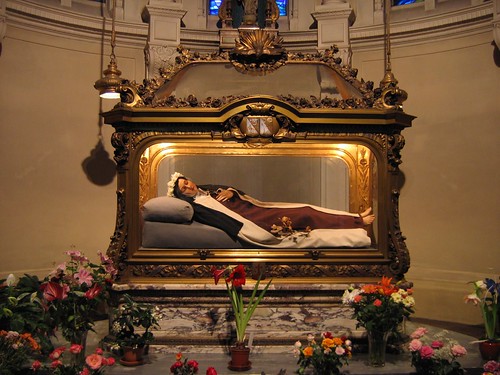 Introduction
 Mary Frances Therese Martin was born at Alencon, France. Her parents were pious individuals who were well endowed with a confortable amount of the goods of the world. Despite all the material possessions, she entered the Carmelite Convent in Lisieux at the age of fifteen; she would spent the next nine years of her life in holiness and humility before expiring at the age of twenty four.
Her ambition to love God perfectly and to conquer souls for Jesus was fulfilled when she died in the odor of sanctity aftering wisphering her very own words of commendation, "My Lord, my God... I love Thee!"
Self-Abandonment
The spirit of self-abandonment that St. Thérèse possesed led her to holiness. What is self-abandonment? Can we abandon ourselves in today's context?
Holy abandonment is one of the purestforms of love; it is the height of love; it is loveing giving to God, unreservedly, our whole being, with all it's energies, activities, concerns, etc... in order that we may be a true and worthy sacrifice to God.
The for example the lives of the monks or cloistered nuns. What makes them holy? What drives them to their lives apart from the world? To do nothing else but pray, meditate, and work? Because these prayer warriors have been given a special grace, the grace of self-abandonment. When the spirit of self-abandonment to God animates a monk's/nun's whole life, that monk/nun has attained holiness.
Holiness
Being holy does not make one a living saint. Being holy also does not mean that a person does not sin; he may sin less, but sins nonetheless. Being holy is substantially the conformity of all our being to God; it is amen said by the whole being and it's faculties to all the rights of God. This is somewhat like Mary's fiat, a fiat full of love, whereby the person responds unceasingly and unfalteringly, to the Divine Will of God.
Our Amen, our Fiat
Dear friends, if we want to do God's Will, if we want to be holy, we must say amen with St. Thérèse and utter our fiat with her. In other words, we need to offer our lives to God like she did. Together with her, let us shout a resounding amen and humble offer our fiat in a spirit of perfect donation whereby the whole being to God is the spirit of abandonment, a spirit which is the sum total of faith, confidence and love. Amen.
Let us pray. O Lord, who had said, "Unless you become as little children you shall not enter the Kingdom of Heaven". Grant we beseech you, so to follow in humility and simplicity of heart the footsteps of Saint Thérèse, the Virgin, that we may obtain everlasting rewards. Saint Thérèse, pray for us. Amen.
Labels: Prayer, Saints, Spirituality
Wednesday, August 15, 2007
The Assumption of the Blessed Virgin Mary

Cf. The Apoc. of St. John 11:19, 12:1-6,10
Today we celebrate Mary's sacred body being lifted into the celestial paradise. Because of her sinless nature, God did not permit her body to corrupt, instead, he commanded His angels to carry her- body and soul united- into Heaven. The Blessed Virgin was met by her Son, Jesus as well as the entire court of Heaven; in their song of triumph.
Because Mary is associated in all the mysteries of our Redemption, she has been placed at the right hand of her son where she may dispose of the treasures of eternal life by a unique title- Mother of God.
Dear brothers and sisters, no amount of exterior work that we do can be as pleasing to God or as useful to the Church and souls as that of loving contemplation, in which we allow God to work in and and through us as He pleases. Mary is the perfect example of this. It was for this very reason that God created her; "Mary has chosen the better part which shall not be taken away from her". Have we learnt this important principal from our Lady?
Mary had the ability to see the Divinity of Jesus in His humanity. No one else had known the inner life of Jesus than she did. If we stay devoted to her, she WILL obtain for us this grace of the knowledge of God and of Jesus.
We must remember that the heart of our Mother is a marvel of mercy. When we fear to go to God beacuse of our sins and unworthiness, we can always go to Mary, because God has entrusted to her the realm of mercy.
Let us continue to ask our Blessed Mother to increase in us a tender and filial love towards God, a love filled with adoration for God and zeal for evangelization. Amen.
Labels: Assumption, Catholic Belief, Mary, Saints
Thursday, July 12, 2007
A Model Priest: St. Fr. Francis A. Fasani

Born and raised in southern Italy, Francis Anthony was a pious and reserved youth who joined the Order at age 14. During the novitiate year he befriended a gregarious novice, Blessed Antonio Lucci. Bl. Antonio Lucci told him that "the fastest way to become a saint was through laughter." These two young friars remained friends and witnessed the importance of close fraternal bonds in the sanctification of self and the world.
Spirituality
St. Francis Fasini was loving, devout and penitential. He was a sought-after confessor and preacher. One witness at the canonical hearings regarding Francesco’s holiness testified, "In his preaching he spoke in a familiar way, filled as he was with the love of God and neighbor; fired by the Spirit, he made use of the words and deed of Holy Scripture, stirring his listeners and moving them to do penance." It is no doubt then, that he is one of the most famous preachers in the Franciscan world.
It was said in Lucera: "Whoever wants to see how St. Francis looked while he was alive should come to see Padre Maestro." In imitation of St. Francis he built his religious life on the basis of a generous participation in the mysteries of Christ through the most faithful practice of the evangelical counsels, which he considered to be a radical expression of perfect charity. In his constant prayers, inflamed with seraphic love, he called out to God, saying to Him: "O Highest Love, Immense Love, Eternal Love, Infinite Love."
Shepherd
The priestly life of Father Anthony Fasani is a splendid testimony to fidelity and dedication to the mission given to all priests in the Church. It is their duty-as Vatican Council II so vigorously confirms-to promote "the glory of God the Father in Christ by their ministry and their life" (PO, 2).
The duty which falls to all priests "to invite all people to conversion and holiness" (PO, 4) was carried out by Fr. Fasani through a type of preaching based on the scriptures that was well prepared, persuasive, and had the particular purpose, as one witness recalled, "of rooting out vices and sins and planting in their place goodness and the exercise of virtue."
As a worthy ministry of "the one who uninterruptedly exercises his priestly mission for us in the Liturgy through the Spirit" (PO, 5), Fr. Fasani dedicated himself with zeal-especially the administration of the sacrament of Penance and the celebration of the Holy Eucharist. "He heard the confession of every type of person," asserted a witness, "with the greatest patience and kindness on his face". He was charitable and welcoming to all, giving as his reason the hope of being able one day to say to the Lord: "I was indulgent, I don't deny it; but it was You who taught me to be so."
He visited and comforted the sick, exhorting them to seek reasons for hope and resignation in the goodness of God. The spiritual care of the imprisoned, an apostolate given him by the bishop of Lucera, permitted him to visit them daily and to exhort them to trust in the merciful love of God. He was given the responsibility of assisting those condemned to death in their last moments.
Eucharistic Priest
The most holy Eucharist was the summit of his religious life and wholly represented the goal toward which be ordered his entire priestly ministry. In fact, he always considered the Eucharist "the source and summit of evangelization," and that the faithful were "fully incorporated into the Body of Christ through the Eucharist" (PO, 5). A fervent minister of the Eucharist, Fr. Fasani celebrated the sacrifice of the Mass with an intense ardor that lifted and nourished his spirit while at the same time it edified all who were present. In his preaching he inculcated in the faithful the love of the Eucharist, promoting even daily communion.
This Is My Paradise
When Fr. Fasani was taken by his final illness in 1742, he wanted to offer it to the Lord in a spirit of perfect joy, with that same expression with which he had always offered God all the actions of his life: "The Will of God: that is my Paradise." On November 2 of the same year, comforted by the holy sacraments and the protection of the Immaculate Virgin Mary for which he prayed, Fr. Francis Anthony Fasani returned his soul to God in the friary of the city where he was born and where, for thirty-five years, he showed himself a faithful witness to Christ.
At his death in Lucera, children ran through the streets and cried out, "The saint is dead! The saint is dead!"
The values of the sacred ministry of the Roman Catholic Priesthood were totally fulfilled in the priestly life of Fr. Francis Anthony Fasani. Vatican Council II expresses this the following terms: "Priests, whether they devote themselves to prayer and adoration, to the preaching of the Word, to offering the Eucharistic Sacrifice and administering the other sacraments, or to carrying out other ministries in the service of mankind, always contribute to the increase of the glory of God and at the same time to enriching mankind with divine life" (PO, 2).
Eventually we become what we choose. If we choose stinginess, we become stingy. If we choose compassion, we become compassionate. The holiness of Francesco Antonio Fasani resulted from his many small decisions to cooperate with God’s grace.
References
- Vatican News Service
- American Catholic Online
Labels: Eucharist, Liturgy, Saints
Friday, June 29, 2007
SS. Peter and Paul, Apostles
 PETER THE APOSTLE AND PAUL THE TEACHER
OF THE NATIONS TAUGHT US YOUR LAW, LORD.
Intrioit: These men, conquering all human frailty, shed their blood and helped the Church to grow. By sharing the cup of the Lord's suffering, they became the friends of God.
Today, the Universal Church commerates Saint Peter and Saint Paul, the princes of the apostles, from whom we dervie our Christian faith. In the Gospel reading (St. Matthew 16:13-19), we will learn how Jesus prepared the fervent Apostle, St. Peter, for the supreme office of the Papacy.
It may be interesting to note that traditionally, this feast was almost entirely devoted to St. Peter, Bishop of Rome, rather than St. Paul, the great apostle of the Gentiles who was more specially honoured on June 30. Today both the Saints receive the same devotion and commemoration. This makes sense as the theme for the Mass recalls the same effect of the Lord's presence in their lives; the Lord always stood by them giving them power so that through them the whole message might be proclaimed for all the world to hear.
This feast marks the day of translation of their relics.
St. Peter
St. Peter preaced the Gospel in Judea after the descent of the Holy Spirit and was cast into prison by Herod Agrippa. Miraculously, an angel delivered him, enabling him to establish his first see at Antioch, and then finally Rome. St. Peter exercised the Supreme Authority vested in him by Christ for twenty-five years before being arrested. He received the crown of martyrdom in 65.
St. Paul
St. Paul was once known as Saul of Tarsus. Saul was a great persecutor of the Christians and wrecked havoc in the Early Church. After a miraculous encounted with God, Saul begain his three great Apostolic Voyages and wrote his Epistles (Paul is the author of many of the Epistles found in the vault of Sacred Scripture). Arriving in Rome after two years of captivity in Caesarea, he travelled to that part of the Church situated beyond Italy before being beheaded in 65.
Let us thank our Heavenly Father for SS. Peter and Paul:
O God who hast made this day holy by the martyrdom of Thine Apsotles Peter and Paul: grant that Thy Church may in all things follow the precepts of those through whom she received the beginnings of the Faith. Keep us true to their teaching so that we may be enabled to share their joy in following the Lord to the unfading inheritance reserved for us in heaven. Through the same Christ our Lord. Amen.
SS. Peter and Paul, pray for us!
Labels: Apostles, Catholic Belief, Early Church, Martyr, Prayer, Quote, Saints
Thursday, June 28, 2007
St. Irenaeus, Bishop, Martyr

IRENAEUS, IN KEEPING WITH HIS NAME, WAS A MAN OF PEACE; HE FOUGHT STRENUOUSLY FOR THE PEACE OF THE CHURCH
Today, the Universal Church commerates St. Irenaeus, bishop and martyr. St. Irenaeus was born at Smyrna about 130 to Grecian Christian parents who were probably from Lesser Asia. His parents placed him under the care of St. Polycarp (the bishop of Smyrna at that time), whom St. Irenaeus became a disciple of. He was well educated and probably knew and was influenced by men who knew the apostles; especially St. Polycarp, who had been a pupil of St. John.
St. Irenaeus became a priest at Lyons, France by the year 177, during the time of persecution there. A powerful defender of the faith against the heresies of the Gnostics, he was soon made bishop of Lyons after his predecessor, St. Pothinus, was martyred.
As bishop he carried on a great and fruitful work: converting all Lyons to Christianity and devoting particular attention to trying to reconcile the numerous sects which menaced the existence of the church. His five-book treatise against the heresy of Gnosticism in Gaul conveys the apostolic tradition in it and is a powerful testimony to the primacy of the Pope.
St. Irenaeus suffered martyrdom about the year 202, under the Emperor Severus, at Lyons.
Let us thank our Heavenly Father for St. Irenaeus:
O God who didst enable the blessed Irenaeus, Thy Martyr and Bishop, to overcome heresies by the truth of doctrine (II Tim. 3:14-17, 4:1-5) and happily to establish peace in the Church: we beseech Thee, give to Thy people constancy in holy religion, and grant us Thy peace in our time. Through the same Christ our Lord. Amen.
St. Irenaeus, pray for us!
Labels: Bishops, Catholic Belief, Early Church, Martyr, Prayer, Quote, Saints
Thursday, June 7, 2007
Now Reading:
 In this book, Fr. Francis Randolph let's his passion for the Most Holy Sacrifice of the Mass 'run wild' by revealing the treasures of the Mass to "people (especially youth) who have been living in poverty (of the Mass) for far too long." The Mass is brought to life with rich illustrations and explainations of every word, gesture, and ritual. Fr. Fancis Randolph makes the Mass very personal and enables the reader to have a more intimate relationship with the Lord during the celebration of the liturgy. In chapter 9, the author also talks about the distinctive contemplative nature of the old rite of Mass that is lacking in the new liturgy.
Even though Fr. Randolph's remains faithful to the magisterial, he presents readers the reality of the Catholic Church as it was during the Second Vatican Council and as it is today. This made the book so controversial that the diocesan censor absolutely condemned it and refused permission for it to be published at first, even though a friendly Archbishop who had read the text approved it and was willing to write an introduction. Fr. Randolph continues to remain faithful to orthodoxy and has not minced his words; he not only inspires devotion but gently corrects error.
'Know Him in the Breaking of the Bread' is a good book that "weaves together liturgical, doctrinal, historical, and spiritual themes," Msgr. Peter Elliot, Author, Ceremonies of the Mordern Roman Rite.
I recommend this book to teachers, catechists, and young people. It would be good to have some knowledge of Church before 1962 in order to understand more clearly what Fr. Randolph's writes in the preface and the Appendix (Chapter 9).
Get this book for S$21.50 from the Archdiocesan Media Center (beside the Church of the Immaculate Heart of Mary) at Highland Road, Kovan.
The Whole World Will Love Me

Already into the 8th chapter (of 37)... this inspiring book by Dorothy Scallan reveals the life of the Little Flower (1873-1897) the time of her conception. I like Dorothy's style of linking the life of the great saint with the historic events that were taking place during her life; it gives a overview of the socio-political environment that St. Therese lived in.
Dorothy Scallan also indulges the reader with 6 chapters on the lives of St. Therese's parents and grandparents (yes... even her grandparents!). It is essential for us to understand the richly-pious Catholic family background in which St. Therese grew up into, in order to appreciate more deeply her life, and more importantly, her love for Jesus.
Get this book for S$28.50 from the Carlo Catholic Society (beside the Church of Sts. Peter and Paul) at Queen Street, Bugis.
Other Books I Want to Purchase:
- Turning Towards the Lord by UM Lang; an argument for the tradition of celebrating Mass facing East, towards Jerusalem. [LITURGY]
- Celebrating the Holy Eucharist by Francis Cardinal Arinze [LITURGY]
- The Mass of the Early Christians by Mike Aquilina [LITURGY]
- Story of a Soul; Autobiography of St. Therese of the Child Jesus [SAINTS/A-BIOGRAPHY]
- Never Stop Walking: The Life and Spirit of St. Alphonsus Liguori by Nancy Fearon, IHM [SAINTS/BIOGRAPHY]
- The Priest in Union With Christ [PRIESTHOOD]
Labels: Books, Catechists, Liturgy, Novus Ordo, Review, Saints, St. Alphonsus Liguori, St. Therese of the Child Jesus
Tuesday, June 5, 2007
The Sacred Heart of Jesus

Quia Rex Sum Ego
This month is dedicated to the Sacred Heart of our Lord Jesus Christ. The Solemnity of the Sacred Heart falls on the Friday after the Second Sunday after Pentecost. This year, the celebration of the Sacred Heart will take place on 15th June.
The Feast of the Sacred Heart was established in order that the faithful might honor with more devotion and zeal, under the symbol of the Sacred Heart, the love of Jesus Christ, which induced Him not only to suffer and to die for the redemption of mankind, but also to institute the Sacrament of His Body and Blood in commeration of His death.
"Behold this Heart which has loved men so much, and yet men do not want to love Me in return. Through you My divine Heart wishes to spread its love everywhere on earth," Jesus to St. Margaret Mary Alacoque.
Devotion to the Sacred Heart was made public by the holy Margaret Mary Alacoque of the Order of the Visitation. In the year 1690, during the Octave of Corpus Christi, our Blessed Lord appeared to His devoted handmaid, disclosing His heart to her saying, "Behold this Heart, which, notwithstanding the burning love for man with which it is consumed and exhausted, meets with no other return from the generality of Christians than sacrilege, contempt, indifference, and ingratitude. My desire is that you should make reparation to my heart for this ingratitude, and induce others also to make reparation."
In several subsequent apparitions our divine Lord repeated this injunction, and made the most unbounded promises in favor' of all who would apply themselves to this office of reparation to His Sacred Heart. The following are some of His promises;
- I will give them all the graces necessary for their state of life.
- I will establish peace in their families.
- I will console them in all their pains and trials.
- I will be their assured refuge in life, and especially in death.
- I will shed abundant blessings upon all their undertakings.
- Sinners shall find in my Heart an infinite ocean of mercy.
- Lukewarm souls will be rendered fervent.
- Fervent souls shall rise rapidly to greater perfection.
- I will bless those houses where the image of my heart shall be exposed and honored.
- I will give to priests the gift of moving the hardest hearts.
- Persons who propagate this devotion,. shall have their names inscribed on my heart, never to be effaced from it.
"The Lord retained until these late centuries the devotion to His Sacred Heart, as a last effort of His divine love," St. Gertrude
The venerable P. Simon Gourdan tells us that it is,
- The most sacred devotion, for by it man venerates the holiest sentiments and emotions of the Heart of Jesus, by which He has sanctified the Church, glorified His Heavenly Father, and presented Himself to us as the perfect model of the most exalted sanctity.
- The oldest devotion of the holy Church, which, instructed by the great St. Paul, has at all times recognized the munificence of the Sacred Heart of Jesus.
- The most approved devotion, for the holy Scriptures everywhere exhort us to renew our heart by changing our lives, rendering them contrite by true penance, inflaming them with the fire of divine love, and adorning them by the exercise of all virtue. Therefore a new heart is promised on which to remodel our Heart. That Heart can be no other than the Heart of Jesus, which is given us as an example of all virtue, and which we must imitate if we wish to be saved.
- The most perfect devotion, for it is the: source of all other devotions; the Heart of Jesus is that inexhaustible treasury from which the Mother of God and all the saints have drawn their graces, their life, their virtues, and all spiritual blessings. Filled from this treasury, other servants of God have instituted different devotions.
- The most useful devotion, for in it we have the Fountain of Life itself before our eyes, from which we can draw directly, and increase in all virtue by adoring this divine Heart, meditating on its holy desires, and seeking to imitate it.
- The devotion most pleasing to Christ, for by it we honor God, as Christ requires, in spirit and in truth, because we adore the interior power of God, seeking to please His heart.
- Finally; the most necessary devotion, for its object is that we become intimately connected as members with Jesus, our Head, that we live by and according to His spirit, and have only one heart and soul with Christ.
Gospel of St. John 29. 31-35
At that time, The Jews, that the bodies might not remain upon the cross on the sabbath-day, besought Pilate that their legs might be broken, and that they might be taken away. The soldiers, therefore, came, and they broke the legs of the first, and of the other that was crucified with him. But after they were come to Jesus, when they saw that he was already dead, they did not break his legs. But one of the soldiers with a spear opened his side, and immediately there came out blood and water. And he that saw it hath given testimony: and his testimony is true.
St. Augustine says: "The Evangelist is very careful in his expression; he does not say, the soldiers pierced or wounded His side, but he o p e n e d it, as if to open for us the door of life, from which flow the Sacraments of the Church, without which there can be no access to the true life."
"Let us remember that the Heart of Jesus has called us not only for our own sanctification, but also for that of other souls. He wants to be helped in the salvation of souls," St. Padre Pio.
Consecration to the Sacred Heart
O Sacred Heart of Jesus, to Thee I consecrate and offer up my person and my life, my actions, trials, and sufferings, that my entire being may henceforth only be employed in loving, honoring and glorifying Thee. This is my irrevocable will, to belong entirely to Thee, and to do all for Thy love, renouncing with my whole heart all that can displease Thee.
I take Thee, O Sacred Heart, for the sole object of my love, the protection of my life, the pledge of my salvation, the remedy of my frailty and insconstancy, the reparation for all the defects of my life, and my secure refuge at the hour of my death. Be Thou, O Most Merciful Heart, my justification before God Thy Father, and screen me from His anger which I have so justly merited. I fear all from my own weakness and malice, but placing my entire confidence in Thee, O Heart of Love, I hope all from Thine infinite Goodness. Annihilate in me all that can displease or resist Thee. Imprint Thy pure love so deeply in my heart that I may never forget Thee or be separated from Thee.
I beseech Thee, through Thine infinite Goodness, grant that my name be engraved upon Thy Heart, for in this I place all my happiness and all my glory, to live and to die as one of Thy devoted servants. Amen.
Documents on the Sacred Heart:
- Annum sacrum (1889) - Pope Leo XIII
- Caritate Christi Compulsi (On The Sacred Heart) - Pope Pius XI
- Miserentissimus Redemptor (On Reparation To The Sacred Heart) - Pope Pius XI
- Haurietis aquas - Pope Pius XII
- Message on the centenary of the consecration of mankind to the Sacred Heart of Jesus (1999) - Pope John Paul ll
Dear readers let us unite our hearts with that of Jesus as we pray: Dear Lord, may the precious rays of water and blood that flowed from your pierced side indue us to pray more fervently and humbly, that we may be induced to discover the treasures of Your heart. Holy Spirit, infuse into our souls the great gift of true compassion for the Most Sacred Heart of Jesus. Blessed Mother pray for us and with us as we make this devout homage of affection to the Most Sacred Heart of your Son, Our Lord Jesus Christ, that we may fulfill our duty of worthy satisfaction. Amen. St. Margaret Mary Alacoque, pray for us.
Acknowledgements/References:
Rev. Fr. Leonard Goffine
1962 Roman Catholic Daily Missal, Angelus Press
A Catholic Life
Miracle of the Rosary Mission
Labels: Catholic Belief, Official Documents, Prayer, Quotes, Sacred Heart of Jesus, Saints
Sunday, June 3, 2007
Chastity, Purity and Our Lady
 Extracted version. For full post, click here. Emphasis completely mine.
......this is the time of grace, this is the time for our souls. It is true, this is a time that we must rise to prayer and pray for our nation. For the first time in a long time I realized how much prayer we must do for our friends and for those who we don't even know. In every Marian Apparition, our Lady has asked for a conversion of heart, for increase in prayer and sacrifice for souls, and this is the time my dear friends.
Teenagers today are having pre-marital sex, using contraceptives and committing other serious sins. Chastity is something that is frowned upon and something that people don't think is attainable in life any more. Our world has been immoralized, because my dear friends, it is true, Chastity is attainable, people are living Chastity; people realize that male and female relationships are meant for procreation not to be against conception. Yes, it is possible to live without viewing pornography and committing sins of the flesh, but yet many people don't live in Chastity, they do commit these sins that are both mortal and serious sins. With prayer and perseverance though one can live a pure lifestyle; it is not impossible.
Let us recall the words of Our Lady of Fatima who said, "More souls go to hell because of sins of the flesh than for any other reason."
These sins are real and people commit them and they do not know what they are doing can endanger their souls, their future happiness with God in Heaven. These are the words of Our Lady at Fatima who appeared in the early 1900's. Today we live in a culture of death, a culture in which sins of the flesh are a lifestyle. Thus we must realize that this is a time for prayer, for prayer for society that they can return back to God.
The Blessed Mother has also appeared here in the United States to a religious sister named Sister Mary Ephrem, and the very first words of Our Lady of America on September 26, 1956 was I am Our Lady of America. I desire that my children honor me, especially by the purity of their lives. Sister Mary Ephrem also said that she was suffering a great deal for she was inconsolable at the thought of her own ingratitude and of the crimes which sinners commit against God.
Our Lady of America encourages us to live lives of purity and in doing so we honor her (the Blessed Mother.) This is the time, more than ever, that we need to pray for our brothers and sisters in society, who do not know God, who do not know the truth or maybe know God but yet choose to sin, we must pray for them daily, that they can know God and to turn away from sin and be faithful to the Gospel.
We must constantly recall the words of Our Blessed Mother that more souls go to Hell because of sins of the flesh. We must be reconciled to God and be ready for the worst, to die tomorrow. We may not accept death easily but we must have peace within our souls, a total conversion, so that we may be with God one day. We do not know the time or the hour in which we leave this earth, likewise then we should always be in God's saving grace.
It is necessary that if we do sin, commit serious sin, that we turn our lives around. Go to confession and ask God to keep you from that sin. Life is tough, we are faced with many temptations, and the devil wants our souls, but we must overcome these sins to be faithful to the Church's teaching which brings us closer to Christ and His mother. We should strive to be like St. Maria Goretti who would rather die than commit a mortal sin.
"Faith begets miracles, the small and the great. Through faith, love and prayer, we can achieve anything.Those people who say that it is impossible to live wholesome, chaste lives cheat themselves and others out of too much." Beez, Commenter on Edward's post.
Also Read:
Labels: Catholic Belief, Confession, Fatima, Mary, Saints, Sex, Sin
Friday, June 1, 2007
St. Justin, Martyr

This great saint was converted from pagan philosophy to Christianity after finding the Christian faith to be "the one certain and profitable philosophy." He St. Justin became one of the most important Christian writers of the second century and was an illustrious opponent of pagan philosophers.
He is most celebrated for the two Apologies (Defences of the Christian faith) which he was courageous enough to address in sucession to the persecuting emperors, Antoninus and Marcus Aurelius. One of them contains a description of the rites of baptism and the ceremonies of Mass, thus constituting the most valuable evidence that we possess on the Roman liturgy of his day.
St. Justin on the Mass,
"And on the day called Sunday, all who live in cities or in the country gather together to one place. And the memoirs of the Apostles or the writings of the Prophets are read, as long as time permits. Then, when the reader has ceased, the priest verbally instructs us and exhorts us to imitate these good things. Then we all rise together and pray. And, as we said before, when our prayer is ended, bread and wine and water are brought. Then, the priest in like manner offers prayers and thanksgivings, according to his ability. And the people assent, saying 'Amen.' Then, the Eucharist, is distributed to everyone, and everyone participates in that over which thanks has been given. And a portion of it is sent by the deacons to those who are absent." St. Justin Martyr ("First Apology," c. 160 A.D.)
Let us thank our Heavenly Father for St. Justin:
O God, Who through the foolishness of the cross didst teach the blessed Martyr Justin the surpassing knowledge of Jesus Christ: enable us by his intercession to put away all deceits of error and obtain steadfastness of faith. Through the same Christ our Lord. Amen.
St. Justin, pray for us!
Acknowledgements:
Labels: Catholic Belief, Early Church, Martyr, Prayer, Quote, Saints
Friday, March 2, 2007
Apologia Against Those Who Decry Holy Images
 St. John the Climacus, St. John of Damascus, St. Arsenius
An Excerpt:
We proclaim Him also by our senses on all sides, and we sanctify the noblest sense, which is that of sight. The image is a memorial, just what words are to a listening ear. What a book is to the literate, that an image is to the illiterate. The image speaks to the sight as words to the ear; it brings us understanding. Hence God ordered the ark to be made of imperishable wood, and to be gilded outside and in, and the tablets to be put in it, and the staff and the golden urn containing the manna, for a remembrance of the past and a type of the future. Who can say these were not images and far-sounding heralds? And they did not hang on the walls of the tabernacle; but in sight of all the people who looked towards them, they were brought forward for the worship and adoration of God, who made use of them. It is evident that they were not worshipped for themselves, but that the people were led through them to remember past signs, and to worship the God of wonders. They were images to serve as recollections, not divine, but leading to divine things by divine power.
Read the full Apologia.
Labels: Apologetics, Catholic Belief, Icons, Links, Saints
Monday, February 12, 2007
The Seven Holy Founders of The Servite Order
Seven noble Florentines founded in 1233 the Order of the Servites of the Blessed Virgin Mary. The Servites led an austere life, meditating constantly on the Passion of our Lord and venerating the Blessed Virgin Mary as Our Lady of Sorrows.
For more information, see EWTN Library.
Labels: Links, Miscellaneous, Saints
Saturday, December 30, 2006
Altar Servers
By Father Chapple,
...... I would like you, as servers, to think seriously about the greatness of the office of serving Holy Mass and to ask St Stephen to help you. You can always have recourse to him even if there is no Guild in your Parish. Never forget the greatness of the privilege you have when you serve. Think about these words of the late Cardinal Bourne who said this about Mass-serving :
" No ministry, except that of those who by Ordination are set apart for the service of the Altar, deserves greater thought and consideration than the duty entrusted to those laymen and youths who have the office of assisting the priests of God in the discharge of their sacred functions."
When you think that those words were written by a Prince of the Church you will realise how important they are. You must ask yourself very seriously, " How do I serve Mass ? Do I need to improve in my serving ? " Many servers have perhaps never thought of the greatness of their task or the grandeur of the privilege they enjoy. This pamphlet will serve as a reminder to them and to you. Above all let us all hope and pray that the words we have read will encourage us to do better in our duties at the Altar; to pray better while we are serving Holy Mass, to get every day closer to the love of Our Lord in the Blessed Sacrament. These things are so necessary if Our Lord is to be served properly, and we all do want to do our very best for Him, do we not?
As a final word of inspiration to all servers wherever you are in the world, study carefully and think deeply on the words which are quoted at the close of this little pamphlet.
A priest has written these words about servers, words whic should be a continual reminder of the greatness of their task :
"All who are considered worthy to serve at the Altar should remember that they are engaged in a work which is the Angels' joy to perform in heaven, the work oi SERVING around the Throne of God and ministering unto Him."
Server ! This is YOUR privilege. Ask St Stephen to make you love your precious task and to accomplish it, even as the Angels, for the love of Almighty God.
Besides St. Stephen, St. John Berchmans is another patron for Altar Servers.
Sunday, December 17, 2006
Feast of Our Lady of Guadalupe

Labels: Fraternity of St. Peter, News, Processions, Saints, Traditionalism
Saturday, December 16, 2006
Litany of St. Michael
Lord, have mercy on us.
Christ, have mercy on us.
Lord, have mercy on us. Christ, hear us.
Christ, graciously hear us.
God the Father of Heaven,
have mercy on us.
God the Son, Redeemer of the world,
have mercy on us.
God the Holy Spirit,
have mercy on us.
Holy Trinity, One God,
have mercy on us.
Response: pray for us.
Holy Mary, Queen of Angels,
Saint Michael,
St. Michael, filled with the wisdom of God,
St. Michael, perfect adorer of the Incarnate Word,
St. Michael, crowned with honor and glory,
St. Michael, most powerful Prince of the armies of the Lord,
St. Michael, standard-bearer of the Most Holy Trinity,
St. Michael, victor over Satan,
St. Michael, guardian of Paradise,
St. Michael, guide and comforter of the people of Israel,
St. Michael, splendor and fortress of the Church Militant,
St. Michael, honor and joy of the Church Triumphant,
St. Michael, light of angels,
St. Michael, bulwark of orthodox believers,
St. Michael, strength of those who fight under the standard of the Cross,
St. Michael, light and confidence of souls at the hour of death,
St. Michael, our most sure aid,
St. Michael, our help in all adversitites,
St. Michael, Herald of the Everlasting Sentence,
St. Michael, Consoler of souls detained in the flames Purgatory,
Thou whom the Lord has charged to receive souls after death,
St. Michael, our Prince,
St. Michael, our Advocate,
Lamb of God, Who takest away the sins of the world,
Spare us, O Lord.
Lamb of God, Who takest away the sins of the world,
Graciously hear us, O Lord.
Lamb of God, Who takest away the sins of the world,
Have mercy on us.
Christ, hear us.
Christ, graciously hear us.
V.Pray for us, O glorious St. Michael, Prince of the Church of Jesus Christ,
R.That we may be made worthy of His promises.
Let Us Pray
Sanctify us, we beseech Thee, O Lord, with Thy holy blessing, and grant us, by the intercession of St. Michael, that wisdom which teaches us to lay up treasures in Heaven by exchanging the goods of this world for those of eternity, Thou Who livest and reignest, world without end.
R. Amen.
Visit The Litany Collection for more Litanies.
Wednesday, December 13, 2006
1 down, 2 to go

Similar to Thomas from American Papist, I'm taking my papers this week. On Tuesday, I took my Micro-Economics and tomorrow I'll be taking my Business Systems paper, followed by Law of Torts on Friday.
Apart form a single flop, it has generally been not too bad, however, it'll be good if you could offer the following prayer for me to the Patron Saint of test takers- St. Joseph Cupertino:
Eternal Father, through the intersession of your servant, Joseph of Cupertino, enlighten my mind to the direction of your Spirit. Help me with these studies that I undertake, and may all of the knowledge that I gain be used to help my brothers and sisters in our Lord Jesus Christ, Amen.
St. Monfort, ora pro me.
Normal blogging will resume after Friday. More on St. Joseph Cupertino from Catholic Encyclopedia.
To all my mates as well as student readers: good luck, may the Divine wisdom be with you.
Tuesday, November 28, 2006
Ora pro nobis...
Saint Joseph, pray for us.
Saints Peter and Paul, pray for us.
Saint Athanasius, pray for us.
Saint Benedict, pray for us.
Pope Saint Gregory the Great, pray for us.
Saint Anthony of Padua, pray for us.
Pope Saint Pius V, pray for us.
Pope Saint Pius X, pray for us.
Saint Jude, pray for us.
Saint Rita, pray for us.
Saint Philomena, pray for us.

Subscribe to Posts [Atom]


